


 Cart
Cart
 sales@molnova.com



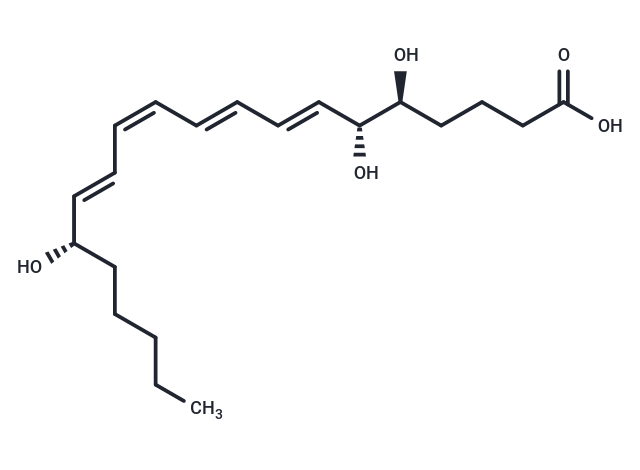
Lipoxin A4
CAS No. 89663-86-5
Lipoxin A4( —— )
Catalog No. M34814 CAS No. 89663-86-5
Lipoxin A4 (LXA4) is a lipoxygenase-derived arachidonate-like mediator with anti-inflammatory properties.Lipoxin A4 attenuates MSU crystal-induced NLRP3 inflammasome activation through inhibition of Nrf2, and regulates M1/M2 macrophage polarization through the FPR2-IRF pathway.
Purity : >98% (HPLC)
 COA
Datasheet
HNMR
HPLC
MSDS
Handing Instructions
COA
Datasheet
HNMR
HPLC
MSDS
Handing Instructions
| Size | Price / USD | Stock | Quantity |
| 100MG | Get Quote | In Stock |


|
| 200MG | Get Quote | In Stock |
|
| 500MG | Get Quote | In Stock |
|
| 1G | Get Quote | In Stock |
|
Biological Information
-
Product NameLipoxin A4
-
NoteResearch use only, not for human use.
-
Brief DescriptionLipoxin A4 (LXA4) is a lipoxygenase-derived arachidonate-like mediator with anti-inflammatory properties.Lipoxin A4 attenuates MSU crystal-induced NLRP3 inflammasome activation through inhibition of Nrf2, and regulates M1/M2 macrophage polarization through the FPR2-IRF pathway.
-
DescriptionLipoxin A4 (LXA4), an endogenous lipoxygenase-derived eicosanoid mediator, has potent dual pro-resolving and anti-inflammatory properties. Lipoxin A4 inhibits proliferation and inflammatory cytokine/chemokine production of human epidermal keratinocytes (NHEKs) associated with the ERK1/2 and NF-kB pathways. Lipoxin A4 inhibits serum amyloid A (SAA)-mediated IL-8 release with an IC50 value of 25.74 nM.
-
In VitroLipoxin A4 (LXA4) inhibits the expression of IL-6 and IL-8 in NHEKs. Lipoxin A4 downregulates the expression of cyclin D1.Lipoxin A4 also suppresses the ERK1/2 phosphorylation and NF-kB-p65 nuclear translocation of NHEKs.LXA4 (100 nM; preincubation for 30 minutes)inhibits the proliferation of NHEKs with or without stimulating by LPS (10 μg/mL). LXA4 pretreatment (100? nM for 30?minutes) downregulates the LPS-induced secretion and expression of HMGB1 in keratinocytes.Cell Proliferation Assay Cell Line:Normal human epidermal keratinocytes (NHEKs) Concentration:100 nM Incubation Time:30 minutes Result:A significant increase in proliferation of NHEKs after 7 days of stimulation with LPS (10 μg/mL) was seen. However, there was a significant decrease in the proliferation of NHEKs when pretreated with LXA4 for 30 min. Western Blot Analysis Cell Line:Normal human epidermal keratinocytes (NHEKs) Concentration:100?nM Incubation Time:30?minutes.Result:HMGB1 protein levels in the cytoplasm of NHEKs were induced by LPS, which were decreased after preincubation with LXA4 but decreased in the nucleus after stimulation with LPS.
-
In Vivo——
-
Synonyms——
-
PathwayProteasome/Ubiquitin
-
TargetEndogenous Metabolite
-
RecptorEndogenous Metabolite | Interleukin
-
Research Area——
-
Indication——
Chemical Information
-
CAS Number89663-86-5
-
Formula Weight352.47
-
Molecular FormulaC20H32O5
-
Purity>98% (HPLC)
-
Solubility——
-
SMILES[C@H]([C@H](CCCC(O)=O)O)(/C=C/C=C/C=C\C=C\[C@H](CCCCC)O)O
-
Chemical Name——
Shipping & Storage Information
-
Storage(-20℃)
-
ShippingWith Ice Pack
-
Stability≥ 2 years
Reference
1. Feng Hu, et al. Lipoxin A4 inhibits proliferation and inflammatory cytokine/chemokine production of human epidermal keratinocytes associated with the ERK1/2 and NF-κB pathways. J Dermatol Sci. 2015 Jun;78(3):181-8.?
molnova catalog



related products
-
N-acetyl-D-Lactosami...
N-acetyl-D-Lactosamine (N-Acetyllactosamine) is a disaccharide consisting of galactose and N-acetylglucose, which is an important component of various oligosaccharides and can be used as a starting material for the synthesis of various oligosaccharides.
-
Alanylphenylalanine
Alanylphenylalanine (Ala-phe) is a compound isolated from the brainstem of calves.
-
Alloepipregnanolone
Alloepipregnanolone is a pregnane with anesthetic hypnotic and sedative properties.
