


 Cart
Cart
 sales@molnova.com



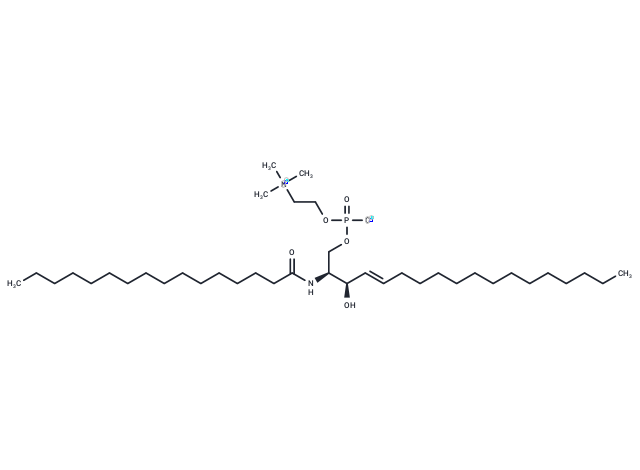
C16 Sphingomyelin (d18:1/16:0)
CAS No. 6254-89-3
C16 Sphingomyelin (d18:1/16:0)( —— )
Catalog No. M34791 CAS No. 6254-89-3
C16 Sphingomyelin (d18:1/16:0) (N-Palmitoyl-D-sphingomyelin) is a phospholipid analog of phospholipid bilayer membranes, which can be used to study biofilm activity.
Purity : >98% (HPLC)
 COA
Datasheet
HNMR
HPLC
MSDS
Handing Instructions
COA
Datasheet
HNMR
HPLC
MSDS
Handing Instructions
| Size | Price / USD | Stock | Quantity |
| 5MG | 371 | In Stock |


|
| 10MG | 556 | In Stock |
|
| 25MG | 872 | In Stock |
|
| 50MG | 1144 | In Stock |
|
| 100MG | 1544 | In Stock |
|
| 200MG | Get Quote | In Stock |
|
| 500MG | Get Quote | In Stock |
|
| 1G | Get Quote | In Stock |
|
Biological Information
-
Product NameC16 Sphingomyelin (d18:1/16:0)
-
NoteResearch use only, not for human use.
-
Brief DescriptionC16 Sphingomyelin (d18:1/16:0) (N-Palmitoyl-D-sphingomyelin) is a phospholipid analog of phospholipid bilayer membranes, which can be used to study biofilm activity.
-
DescriptionN-Palmitoyl-D-sphingomyelin (Sphingomyelin 16:0) (Compound SM-03) can be used for the synthesis of lipid nanoparticles.
-
In Vitro——
-
In Vivo——
-
Synonyms——
-
PathwayProteasome/Ubiquitin
-
TargetEndogenous Metabolite
-
RecptorEndogenous Metabolite
-
Research Area——
-
Indication——
Chemical Information
-
CAS Number6254-89-3
-
Formula Weight703.03
-
Molecular FormulaC39H79N2O6P
-
Purity>98% (HPLC)
-
Solubility——
-
SMILES[C@H](NC(CCCCCCCCCCCCCCC)=O)(COP(OCC[N+](C)(C)C)(=O)[O-])[C@@H](/C=C/CCCCCCCCCCCCC)O
-
Chemical Name——
Shipping & Storage Information
-
Storage(-20℃)
-
ShippingWith Ice Pack
-
Stability≥ 2 years
Reference
1. Dandan LING, et al. Lipid compounds and lipid nanoparticle compositions. Patent. WO2023056914.
molnova catalog



related products
-
(S)-3-Hydroxybutanoi...
(S)-3-Hydroxybutyric acid is a normal human metabolite that has been found elevated in geriatric patients remitting from depression.
-
11(Z),14(Z),17(Z)-Ei...
11(Z),14(Z),17(Z)-Eicosatrienoic acid is an unsaturated fatty acid capable of maintaining continuous replication of functional mitochondria in Saccharomyces cerevisiae (KD115).
-
Taurodeoxycholate so...
Taurodeoxycholate sodium salt is a bile salt-related anionic detergent used for isolation of membrane proteins including inner mitochondrial membrane proteins. and it inhibits various inflammatory responses
