


 Cart
Cart
 sales@molnova.com


 Home -
Products -
Proteasome/Ubiquitin -
Endogenous Metabolite -
11(Z),14(Z),17(Z)-Eicosatrienoic acid
Home -
Products -
Proteasome/Ubiquitin -
Endogenous Metabolite -
11(Z),14(Z),17(Z)-Eicosatrienoic acid
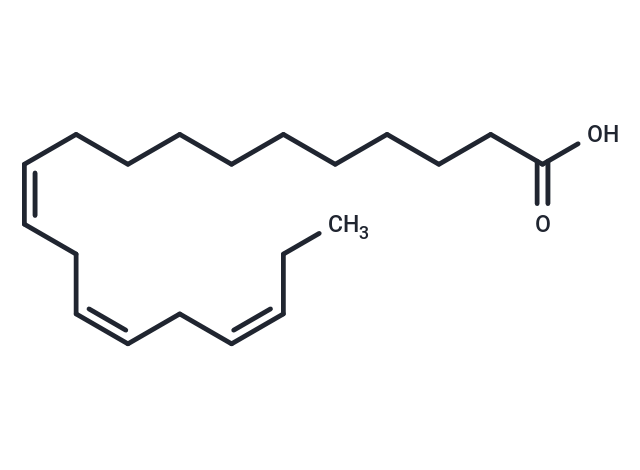
11(Z),14(Z),17(Z)-Eicosatrienoic acid
CAS No. 17046-59-2
11(Z),14(Z),17(Z)-Eicosatrienoic acid( —— )
Catalog No. M37541 CAS No. 17046-59-2
11(Z),14(Z),17(Z)-Eicosatrienoic acid is an unsaturated fatty acid capable of maintaining continuous replication of functional mitochondria in Saccharomyces cerevisiae (KD115).
Purity : >98% (HPLC)
 COA
Datasheet
HNMR
HPLC
MSDS
Handing Instructions
COA
Datasheet
HNMR
HPLC
MSDS
Handing Instructions
| Size | Price / USD | Stock | Quantity |
| 5MG | 28 | In Stock |


|
| 100MG | Get Quote | In Stock |
|
| 200MG | Get Quote | In Stock |
|
| 500MG | Get Quote | In Stock |
|
| 1G | Get Quote | In Stock |
|
Biological Information
-
Product Name11(Z),14(Z),17(Z)-Eicosatrienoic acid
-
NoteResearch use only, not for human use.
-
Brief Description11(Z),14(Z),17(Z)-Eicosatrienoic acid is an unsaturated fatty acid capable of maintaining continuous replication of functional mitochondria in Saccharomyces cerevisiae (KD115).
-
Description11(Z),14(Z),17(Z)-Eicosatrienoic acid is an unsaturated fatty acid capable of maintaining continuous replication of functional mitochondria in Saccharomyces cerevisiae (KD115).
-
In Vitro——
-
In Vivo——
-
Synonyms——
-
PathwayProteasome/Ubiquitin
-
TargetEndogenous Metabolite
-
RecptorEndogenous Metabolite
-
Research Area——
-
Indication——
Chemical Information
-
CAS Number17046-59-2
-
Formula Weight306.48
-
Molecular FormulaC20H34O2
-
Purity>98% (HPLC)
-
Solubility——
-
SMILESC(CC/C=C\C/C=C\C/C=C\CC)CCCCCCC(O)=O
-
Chemical Name——
Shipping & Storage Information
-
Storage(-20℃)
-
ShippingWith Ice Pack
-
Stability≥ 2 years
Reference
molnova catalog



related products
-
H-Gly-Pro-OH
H-Gly-Pro-OH is a dipeptide composed of glycine and proline and is an end product of collagen metabolism.
-
3-(2-Hydroxyphenyl)p...
3-(2-Hydroxyphenyl)propanoic acid also known as melilotic acid or melilotate. Within the cell 3-(2-hydroxyphenyl)propanoic acid is primarily located in the cytoplasm. 3-(2-Hydroxyphenyl)propanoic acid can be biosynthesized from propionic acid.
-
Zinc Protoporphyrin
Zinc Protoporphyrin is an orally active and competitive inhibitor of heme oxygenase-1 (HO-1) and markedly attenuates the protective effects of Phloroglucinol (PG) against H2O2, and has anti-cancer activity.
