


 Cart
Cart
 sales@molnova.com



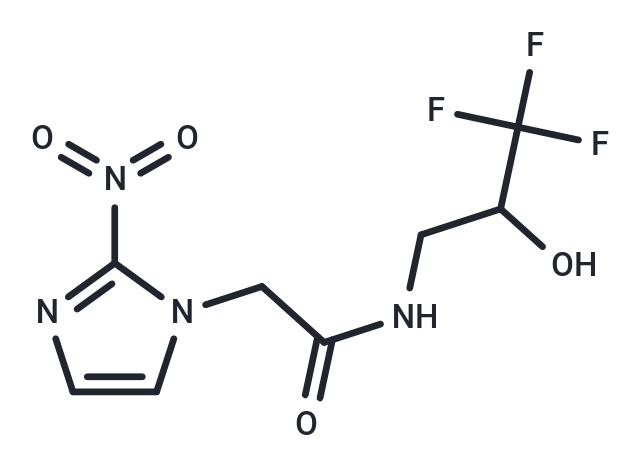
SR4554
CAS No. 167648-73-9
SR4554( —— )
Catalog No. M34714 CAS No. 167648-73-9
SR4554 is a fluorinated 2-nitroimidazole non-invasive tumor hypoxia probe for the detection of tumor hypoxia as detected by 19F magnetic resonance spectroscopy (MRS).
Purity : >98% (HPLC)
 COA
Datasheet
HNMR
HPLC
MSDS
Handing Instructions
COA
Datasheet
HNMR
HPLC
MSDS
Handing Instructions
| Size | Price / USD | Stock | Quantity |
| 5MG | 686 | In Stock |


|
| 10MG | 938 | In Stock |
|
| 25MG | 1444 | In Stock |
|
| 50MG | 1841 | In Stock |
|
| 100MG | Get Quote | In Stock |
|
| 200MG | Get Quote | In Stock |
|
| 500MG | Get Quote | In Stock |
|
| 1G | Get Quote | In Stock |
|
Biological Information
-
Product NameSR4554
-
NoteResearch use only, not for human use.
-
Brief DescriptionSR4554 is a fluorinated 2-nitroimidazole non-invasive tumor hypoxia probe for the detection of tumor hypoxia as detected by 19F magnetic resonance spectroscopy (MRS).
-
DescriptionSR4554 is a fluorinated 2-nitroimidazole non-invasive tumor hypoxia probe for the detection of tumor hypoxia as detected by 19F magnetic resonance spectroscopy (MRS).
-
In Vitro——
-
In Vivo——
-
Synonyms——
-
PathwayOthers
-
TargetOther Targets
-
RecptorOthers
-
Research Area——
-
Indication——
Chemical Information
-
CAS Number167648-73-9
-
Formula Weight282.18
-
Molecular FormulaC8H9F3N4O4
-
Purity>98% (HPLC)
-
Solubility——
-
SMILESO=C(NCC(O)C(F)(F)F)CN1C=CN=C1N(=O)=O
-
Chemical Name——
Shipping & Storage Information
-
Storage(-20℃)
-
ShippingWith Ice Pack
-
Stability≥ 2 years
Reference
molnova catalog



related products
-
Solvent Yellow 16
Solvent Yellow 16, a disperse dye, is a coloring agent in cosmetics.
-
(R)-Reticuline
(R)-Reticuline is the biosynthetic precursor of the morphinan alkaloids.
-
LDC195943(IMT1)
Anticancer.
