


 Cart
Cart
 sales@molnova.com



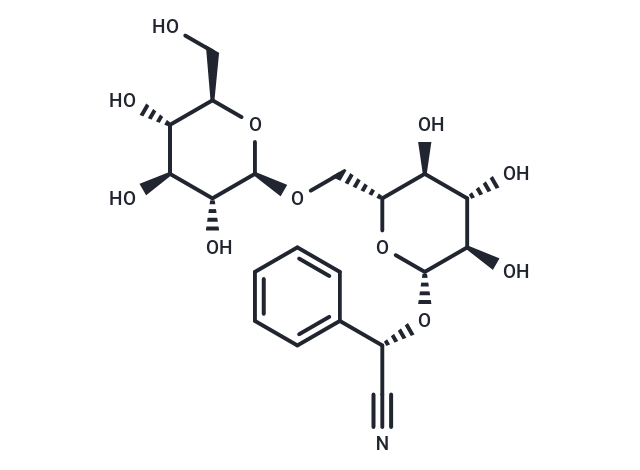
Neoamygdalin
CAS No. 29883-16-7
Neoamygdalin( —— )
Catalog No. M34667 CAS No. 29883-16-7
Neoamygdalin is a bioactive chemical.
Purity : >98% (HPLC)
 COA
Datasheet
HNMR
HPLC
MSDS
Handing Instructions
COA
Datasheet
HNMR
HPLC
MSDS
Handing Instructions
| Size | Price / USD | Stock | Quantity |
| 5MG | 297 | In Stock |


|
| 10MG | 471 | In Stock |
|
| 25MG | 753 | In Stock |
|
| 50MG | 995 | In Stock |
|
| 100MG | 1349 | In Stock |
|
| 200MG | 1823 | In Stock |
|
| 500MG | Get Quote | In Stock |
|
| 1G | Get Quote | In Stock |
|
Biological Information
-
Product NameNeoamygdalin
-
NoteResearch use only, not for human use.
-
Brief DescriptionNeoamygdalin is a bioactive chemical.
-
DescriptionNeoamygdalin is a compound identified in the different processed bitter almonds. Neoamygdalin has the potential for the research of cough and asthma.
-
In Vitro——
-
In Vivo——
-
Synonyms——
-
PathwayOthers
-
TargetOther Targets
-
RecptorOthers
-
Research Area——
-
Indication——
Chemical Information
-
CAS Number29883-16-7
-
Formula Weight457.43
-
Molecular FormulaC20H27NO11
-
Purity>98% (HPLC)
-
SolubilityIn Vitro:?DMSO : 100 mg/mL (218.61 mM; Ultrasonic )
-
SMILESOC[C@H]1O[C@@H](OC[C@H]2O[C@@H](O[C@H](C#N)c3ccccc3)[C@H](O)[C@@H](O)[C@@H]2O)[C@H](O)[C@@H](O)[C@@H]1O
-
Chemical Name——
Shipping & Storage Information
-
Storage(-20℃)
-
ShippingWith Ice Pack
-
Stability≥ 2 years
Reference
1. Xu S, et al. Identification and Analysis of Amygdalin, Neoamygdalin and Amygdalin Amide in Different Processed Bitter Almonds by HPLC-ESI-MS/MS and HPLC-DAD. Molecules. 2017;22(9):1425.?
molnova catalog



related products
-
MQAE
MQAE, a fluorescent chloride ion indicator, is more sensitive and selective than 36Cl and microelectrode-based methods for chloride measurement in cells.
-
Fumagillol
Fumagillol is a direct precursor of the potent angiogenesis inhibitors TNP-470 and fumagillin.
-
Antroquinonol
Antroquinonol is a ubiquinone derivative from Antrodia camphorata with anti-inflammatory and anticancer activities.Antroquinonol reduces oxidative stress and inhibits inflammation and sclerosis in mice with focal segmental glomerulosclerosis through enhancement of the Nrf2 signaling pathway.
