


 Cart
Cart
 sales@molnova.com



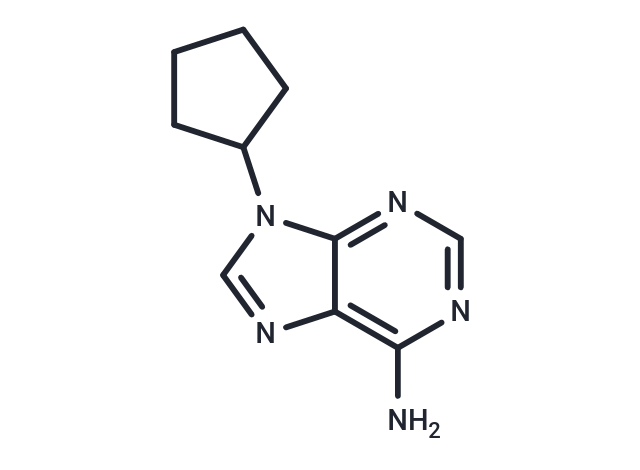
9-Cyclopentyladenine
CAS No. 715-91-3
9-Cyclopentyladenine( —— )
Catalog No. M34489 CAS No. 715-91-3
9-Cyclopentyladenine (NSC-19486) is an adenylate cyclase inhibitor that blocks cellular morphological differentiation and phosphorylation of specific signaling molecules.
Purity : >98% (HPLC)
 COA
Datasheet
HNMR
HPLC
MSDS
Handing Instructions
COA
Datasheet
HNMR
HPLC
MSDS
Handing Instructions
| Size | Price / USD | Stock | Quantity |
| 5MG | 409 | In Stock |


|
| 10MG | 604 | In Stock |
|
| 25MG | 938 | In Stock |
|
| 50MG | 1265 | In Stock |
|
| 100MG | 1702 | In Stock |
|
| 200MG | Get Quote | In Stock |
|
| 500MG | 3422 | In Stock |
|
| 1G | Get Quote | In Stock |
|
Biological Information
-
Product Name9-Cyclopentyladenine
-
NoteResearch use only, not for human use.
-
Brief Description9-Cyclopentyladenine (NSC-19486) is an adenylate cyclase inhibitor that blocks cellular morphological differentiation and phosphorylation of specific signaling molecules.
-
Description9-Cyclopentyladenine (NSC-19486) is an adenylate cyclase inhibitor that blocks cellular morphological differentiation and phosphorylation of specific signaling molecules.
-
In Vitro——
-
In Vivo——
-
Synonyms——
-
PathwayCell Cycle/DNA Damage
-
TargetAChR
-
RecptorAChR
-
Research Area——
-
Indication——
Chemical Information
-
CAS Number715-91-3
-
Formula Weight203.24
-
Molecular FormulaC10H13N5
-
Purity>98% (HPLC)
-
Solubility——
-
SMILESNC1=C2C(N(C=N2)C3CCCC3)=NC=N1
-
Chemical Name——
Shipping & Storage Information
-
Storage(-20℃)
-
ShippingWith Ice Pack
-
Stability≥ 2 years
Reference
molnova catalog



related products
-
Tazomeline
Tazomeline is a muscarinic M1 receptor agonist with neuroprotective activity.
-
TC-2216
TC-2216 is a partial agonist at the neural nicotinic acetylcholine receptor and is used to treat anxiety and depression.
-
McN-A 343
McN-A 343 is a selective M1 muscarinic agonist known for its ability to stimulate muscarinic transmission in sympathetic ganglia.
