


 Cart
Cart
 sales@molnova.com



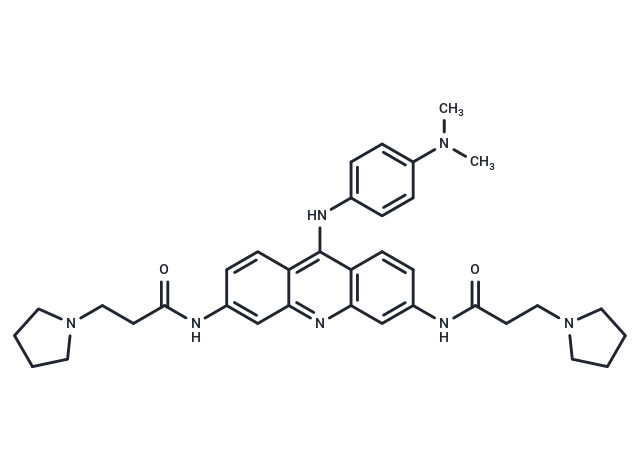
Braco-19
CAS No. 351351-75-2
Braco-19( —— )
Catalog No. M34194 CAS No. 351351-75-2
Braco-19 is a telomerase/telomere inhibitor and an inhibitor of HAdV viral replication with antiviral activity that reduces lipid vacuolization in adipocytes, inhibits proliferation and decreases telomerase activity in human glioblastoma cells.
Purity : >98% (HPLC)
 COA
Datasheet
HNMR
HPLC
MSDS
Handing Instructions
COA
Datasheet
HNMR
HPLC
MSDS
Handing Instructions
| Size | Price / USD | Stock | Quantity |
| 2MG | 73 | Get Quote |


|
| 5MG | 107 | Get Quote |
|
| 10MG | 180 | Get Quote |
|
| 25MG | 380 | Get Quote |
|
| 50MG | 605 | Get Quote |
|
| 100MG | 845 | Get Quote |
|
| 500MG | Get Quote | Get Quote |
|
| 1G | Get Quote | Get Quote |
|
Biological Information
-
Product NameBraco-19
-
NoteResearch use only, not for human use.
-
Brief DescriptionBraco-19 is a telomerase/telomere inhibitor and an inhibitor of HAdV viral replication with antiviral activity that reduces lipid vacuolization in adipocytes, inhibits proliferation and decreases telomerase activity in human glioblastoma cells.
-
DescriptionBraco-19 is a potent telomerase/telomere inhibitor, preventing the capping and catalytic action of telomerase. Braco-19 acts as G-quadruplex (GQ) binding ligand, stabilizing G-quadruplexes formation at the 3V telomeric DNA overhang and produce rapid senescence or selective cell death. Braco-19 is also a HAdV virus replication inhibitor.
-
In VitroBraco-19, as a well-known GQ binding ligand, interacts specifically with the HAdV GQs and increases their stability, and blocks the HAdV multiplication.BRACO-19 (1.0-10 μM; 5 day) cause zero growth inhibition is found 1 μM, the IC50 for BRACO-19 in UXF1138L cells is 2.5 μM, the IC100 is 5 μM.BRACO-19 (1 μM; 24 hours) shows dramatically reduced nuclear hTERT expression. However, residual cytoplasmic hTERT staining is observed accompanied by the occurrence of atypical mitoses.BRACO-19 (0-40 μM; 24 hours) decreases the AdV virus growth in a dose-dependent manner in eGFP-transinfected HEK 293 cells.BRACO-19 (0-150 μM; 24 hours) shows a decrease in band intensity in an increasing concentration-dependent manner.Cell Viability Assay Cell Line:HEK 293 cells Concentration:20 μM; 40 μM Incubation Time:24 hours Result:Displayed low cytotoxicity and decreased the eGFP fluorescence.
-
In VivoBRACO-19 (oral administration or intraperitoneal injection; 2 or 5 mg/kg; 3 weeks) oral dosing regimen are always inactive and the animals have to be sacrificed due to high tumor burden before overall termination of the study, Chronic, i.p. BRACO-19 administration, qdx5 is efficient in inhibiting tumor growth in earlystage xenografts but not advanced-stage xenografts. BRACO-19 (intraperitoneal injection; 2 mg/kg; 3 weeks; starting 6 days after transplantation of UXF1138LX fragments) inhibits tumor growth significantly and under these conditions, marked single-agent antitumor activity is observed, with some animals in the group showing complete regressions (5 of 12 tumors).Animal Model:Established UXF1138LX Xenografts in nude miceDosage:2 mg/kg Administration:Intraperitoneal injection; 3 weeks; starting 6 days after transplantation of UXF1138LX fragments Result:Showed partial tumor regressions with an optimal T/C on day 28 of 4.1%, equal to 95.9% inhibition of tumor growth compared with control.
-
Synonyms——
-
PathwayCell Cycle/DNA Damage
-
TargetTelomerase
-
RecptorTelomerase | Antiviral
-
Research Area——
-
Indication——
Chemical Information
-
CAS Number351351-75-2
-
Formula Weight593.76
-
Molecular FormulaC35H43N7O2
-
Purity>98% (HPLC)
-
SolubilityIn Vitro:?DMSO : 33.33 mg/mL (56.13 mM; Ultrasonic )
-
SMILESO=C(NC=1C=CC2=C(N=C3C=C(C=CC3=C2NC4=CC=C(C=C4)N(C)C)NC(=O)CCN5CCCC5)C1)CCN6CCCC6
-
Chemical Name——
Shipping & Storage Information
-
Storage(-20℃)
-
ShippingWith Ice Pack
-
Stability≥ 2 years
Reference
1. Angelika M Burger, et al. The G-quadruplex-interactive Molecule BRACO-19 Inhibits Tumor Growth, Consistent With Telomere Targeting and Interference With Telomerase Function. Cancer Res. 2005 Feb 15;65(4):1489-96.?
molnova catalog



related products
-
MST-312
MST-312 is an inhibitor of telomerase and can be used in studies about cancer, such as multiple myeloma.
-
Telomerase-IN-2
Telomerase-IN-2 shows potent inhibitory activity against telomerase by decreasing the expression of dyskerin (IC50: 0.89?μM).
-
DihydroarteMisinic a...
Dihydroartemisinic acid is a natural product from Artemisia annua and the main direct precursor of artemisinin, which is a medicinal herb that is widely used to treat Malaria.
