


 Cart
Cart
 sales@molnova.com



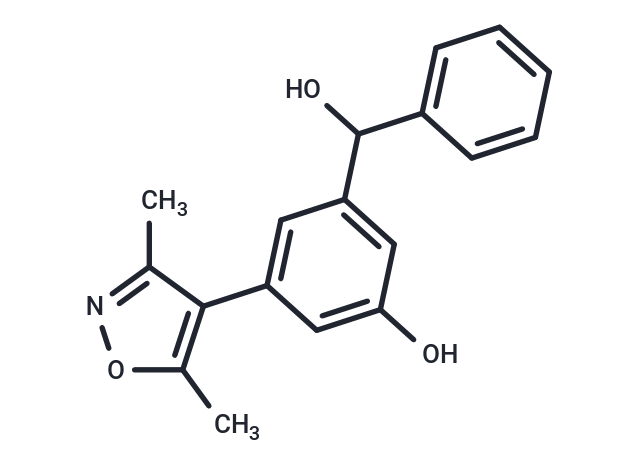
OXF BD 02
CAS No. 1429129-68-9
OXF BD 02( —— )
Catalog No. M33898 CAS No. 1429129-68-9
OXF BD 02 is a potent and selective BRD4(1) inhibitor (IC50: 382 nM) with anticancer and anti-inflammatory activity.
Purity : >98% (HPLC)
 COA
Datasheet
HNMR
HPLC
MSDS
Handing Instructions
COA
Datasheet
HNMR
HPLC
MSDS
Handing Instructions
| Size | Price / USD | Stock | Quantity |
| 5MG | 235 | In Stock |


|
| 10MG | 353 | In Stock |
|
| 25MG | 655 | In Stock |
|
| 50MG | 917 | In Stock |
|
| 100MG | 1228 | In Stock |
|
| 200MG | Get Quote | In Stock |
|
| 500MG | 2474 | In Stock |
|
| 1G | Get Quote | In Stock |
|
Biological Information
-
Product NameOXF BD 02
-
NoteResearch use only, not for human use.
-
Brief DescriptionOXF BD 02 is a potent and selective BRD4(1) inhibitor (IC50: 382 nM) with anticancer and anti-inflammatory activity.
-
DescriptionOXF BD 02 is a selective inhibitor of BRD4(1) (the first bromodomain of BRD4) with IC50value of 382 nM.
-
In Vitro——
-
In Vivo——
-
Synonyms——
-
PathwayChromatin/Epigenetic
-
TargetEpigenetic Reader Domain
-
RecptorEpigenetic Reader Domain
-
Research Area——
-
Indication——
Chemical Information
-
CAS Number1429129-68-9
-
Formula Weight295.33
-
Molecular FormulaC18H17NO3
-
Purity>98% (HPLC)
-
Solubility——
-
SMILESCC=1C(C2=CC(C(O)C3=CC=CC=C3)=CC(O)=C2)=C(C)ON1
-
Chemical Name——
Shipping & Storage Information
-
Storage(-20℃)
-
ShippingWith Ice Pack
-
Stability≥ 2 years
Reference
1. Hewings DS, et al. Optimization of 3,5-dimethylisoxazole derivatives as potent bromodomain ligands. J Med Chem. 2013 Apr 25;56(8):3217-27. ?
molnova catalog



related products
-
CPI-203
CPI-203 is a potent BET bromodomain inhibitor with IC50 of 37 nM for BRD4.
-
CREB inhibitor
666-15 is a potent and selective CREB inhibitor (IC50: 81 nM).
-
NEO2734
NEO2734 is an orally active and selective inhibitor of p300/CBP and BET bromodomain(IC50 of <30 nM for both p300/CBP and BET bromodomains).
