


 Cart
Cart
 sales@molnova.com



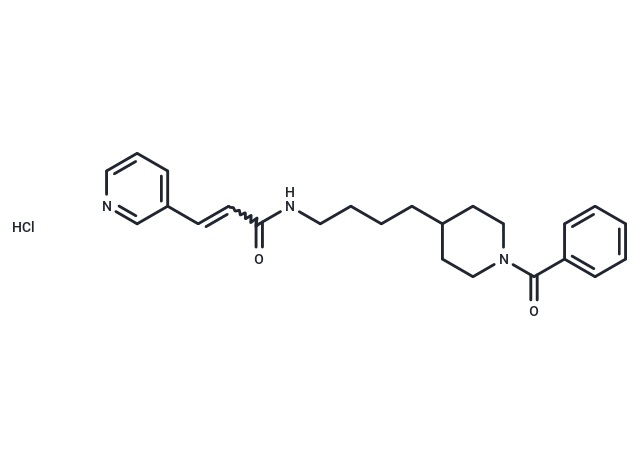
Daporinad hydrochloride
CAS No. 1785666-54-7
Daporinad hydrochloride( —— )
Catalog No. M33851 CAS No. 1785666-54-7
Daporinad hydrochloride (FK 866 hydrochloride) is a potent nicotinamide-phosphate ribosyltransferase (NAMPT) inhibitor with potential anti-tumor and anti-angiogenic activity that induces apoptosis in tumor cells.
Purity : >98% (HPLC)
 COA
Datasheet
HNMR
HPLC
MSDS
Handing Instructions
COA
Datasheet
HNMR
HPLC
MSDS
Handing Instructions
| Size | Price / USD | Stock | Quantity |
| 1 mL x 10 mM in DMSO | 74 | In Stock |


|
| 2MG | 46 | In Stock |
|
| 100MG | Get Quote | In Stock |
|
| 200MG | Get Quote | In Stock |
|
| 500MG | Get Quote | In Stock |
|
| 1G | Get Quote | In Stock |
|
Biological Information
-
Product NameDaporinad hydrochloride
-
NoteResearch use only, not for human use.
-
Brief DescriptionDaporinad hydrochloride (FK 866 hydrochloride) is a potent nicotinamide-phosphate ribosyltransferase (NAMPT) inhibitor with potential anti-tumor and anti-angiogenic activity that induces apoptosis in tumor cells.
-
DescriptionDaporinad hydrochloride (FK 866 hydrochloride) is a potent nicotinamide-phosphate ribosyltransferase (NAMPT) inhibitor with potential anti-tumor and anti-angiogenic activity that induces apoptosis in tumor cells.Daporinad hydrochloride can be used in the study of inflammation and cancer.
-
In Vitro——
-
In Vivo——
-
Synonyms——
-
PathwayApoptosis
-
TargetApoptosis
-
RecptorApoptosis | NAMPT
-
Research Area——
-
Indication——
Chemical Information
-
CAS Number1785666-54-7
-
Formula Weight427.97
-
Molecular FormulaC24H30ClN3O2
-
Purity>98% (HPLC)
-
Solubility——
-
SMILESCl.O=C(C=CC=1C=NC=CC1)NCCCCC2CCN(C(=O)C=3C=CC=CC3)CC2
-
Chemical Name——
Shipping & Storage Information
-
Storage(-20℃)
-
ShippingWith Ice Pack
-
Stability≥ 2 years
Reference
molnova catalog



related products
-
Pamrevlumab
Pamrevlumab (FG-3019) is a human antibody with affinity for connective tissue growth factor (CTGF) and is involved in anti-CTGF therapy for the treatment of idiopathic pulmonary fibrosis (IPF).
-
LYN-1604 dihydrochlo...
LYN-1604 is a novel ULK1 activator.It inducing cell death involved in ATF3, RAD21, and caspase3, accompanied by autophagy and apoptosis.
-
WM-3835
WM-3835 is a novel and high-specific small molecule?inhibitor of Lysine Acetyltransferase 7 (KAT7, MYST2, HBO1)?, able to potently suppressed OS cell proliferation and migration, and leads to?apoptosis?activation.
