


 Cart
Cart
 sales@molnova.com



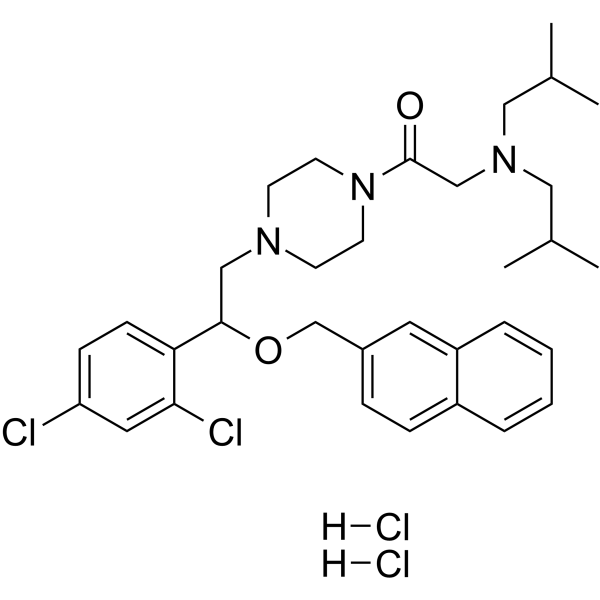
LYN-1604 dihydrochloride
CAS No. 2310109-38-5
LYN-1604 dihydrochloride( LYN-1604 2HCl(2216753-86-3 free basel) | )
Catalog No. M28580 CAS No. 2310109-38-5
LYN-1604 is a novel ULK1 activator.It inducing cell death involved in ATF3, RAD21, and caspase3, accompanied by autophagy and apoptosis.
Purity : >98% (HPLC)
 COA
Datasheet
HNMR
HPLC
MSDS
Handing Instructions
COA
Datasheet
HNMR
HPLC
MSDS
Handing Instructions
| Size | Price / USD | Stock | Quantity |
| 1 mL x 10 mM in DMSO | 98 | In Stock |


|
| 5MG | 67 | In Stock |
|
| 10MG | 113 | In Stock |
|
| 25MG | 212 | In Stock |
|
| 50MG | 310 | In Stock |
|
| 100MG | 437 | In Stock |
|
| 200MG | 616 | In Stock |
|
| 500MG | Get Quote | In Stock |
|
| 1G | Get Quote | In Stock |
|
Biological Information
-
Product NameLYN-1604 dihydrochloride
-
NoteResearch use only, not for human use.
-
Brief DescriptionLYN-1604 is a novel ULK1 activator.It inducing cell death involved in ATF3, RAD21, and caspase3, accompanied by autophagy and apoptosis.
-
DescriptionLYN-1604 is a novel ULK1 activator.It inducing cell death involved in ATF3, RAD21, and caspase3, accompanied by autophagy and apoptosis.(In Vitro):LYN-1604, to be the best candidate for a ULK1 agonist. LYN-1604 induced cell death involved in ATF3, RAD21, and caspase3, accompanied by autophagy and apoptosis. LYN-1604 has potential for good therapeutic effects on TNBC by targeting ULK1-modulated cell death in vivo
-
In VitroCell Viability Assay Cell Line:MDA-MB-231 cells Concentration:0.5, 1.0 and 2.0 μM Incubation Time:Result:Induced cell death.Autophagy ratio was increased in a dose-dependent manner.Western Blot Analysis Cell Line:MDA-MB-231 cells Concentration:0, 0.5, 1, and 2 μM Incubation Time:24 hours Result:Induced remarkable up-regulation of Beclin-1 and degradation of p62, as well as transformation of LC3-I to LC3-II.
-
In VivoAnimal Model:24 female nude mice (BALB/c, 6-8 weeks, 20-22 g) Dosage:Low dose, 25 mg/kg; median dose, 50 mg/kg; high dose, 100 mg/kg Administration:Intragastric administration; once a day for 14 days Result:Significantly inhibited the growth of xenograft MDA-MB-231 cells. The body weights of mice were stable. By the end of the experiment, the liver and spleen weight indexes of mice were slightly increased in parts of the groups, while the kidney weight index was not affected in all dose groups.
-
SynonymsLYN-1604 2HCl(2216753-86-3 free basel) |
-
PathwayApoptosis
-
TargetApoptosis
-
Recptor——
-
Research Area——
-
Indication——
Chemical Information
-
CAS Number2310109-38-5
-
Formula Weight657.54
-
Molecular FormulaC33H45Cl4N3O2
-
Purity>98% (HPLC)
-
SolubilityIn Vitro:?H2O : 50 mg/mL (76.04 mM)
-
SMILES[H]Cl.[H]Cl.ClC1=CC=C(C(OCC2=CC=C3C=CC=CC3=C2)CN4CCN(C(CN(CC(C)C)CC(C)C)=O)CC4)C(Cl)=C1
-
Chemical Name——
Shipping & Storage Information
-
Storage(-20℃)
-
ShippingWith Ice Pack
-
Stability≥ 2 years
Reference
1.Liang WL, et al. Exploring the chemodiversity and biological activities of the secondary metabolites from the marine fungus Neosartorya pseudofischeri. Mar Drugs. 2014 Nov 24;12(11):5657-76.
molnova catalog



related products
-
Isatuximab
Isatuximab is a monoclonal antibody targeting the transmembrane receptor and extracellular enzyme CD38 in malignant cells of the hematological system, a highly expressed protein in multiple myeloma.
-
Oxypalmatine
Oxypalmatine (8-Oxypalmatine) is a berberine-type alkaloid isolated from Phellodendron amurense that regulates breast cancer cell proliferation and apoptosis by inhibiting PI3K/AKT signaling and its efficacy in breast cancer-like organs.
-
Sparfosic Acid
Sparfosic Acid (Acide sparfosique) is an aspartate carbamoyltransferase inhibitor with antitumor activity and can be used to study advanced renal cell carcinoma.
