


 Cart
Cart
 sales@molnova.com



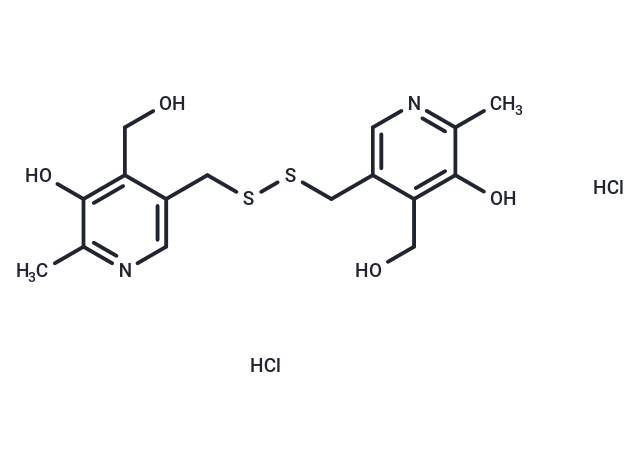
Pyrithioxin dihydrochloride
CAS No. 10049-83-9
Pyrithioxin dihydrochloride( —— )
Catalog No. M33686 CAS No. 10049-83-9
Pyrithioxin dihydrochloride (Pyrithioxine HCl) has anti-nociceptive and anti-allodynic effects, can promote the metabolism of glucose and amino acids in the brain, improve systemic assimilation, and can be used to study neurological diseases such as atherosclerosis.
Purity : >98% (HPLC)
 COA
Datasheet
HNMR
HPLC
MSDS
Handing Instructions
COA
Datasheet
HNMR
HPLC
MSDS
Handing Instructions
| Size | Price / USD | Stock | Quantity |
| 50MG | 30 | In Stock |


|
| 100MG | 45 | In Stock |
|
| 200MG | Get Quote | In Stock |
|
| 500MG | Get Quote | In Stock |
|
| 1G | Get Quote | In Stock |
|
Biological Information
-
Product NamePyrithioxin dihydrochloride
-
NoteResearch use only, not for human use.
-
Brief DescriptionPyrithioxin dihydrochloride (Pyrithioxine HCl) has anti-nociceptive and anti-allodynic effects, can promote the metabolism of glucose and amino acids in the brain, improve systemic assimilation, and can be used to study neurological diseases such as atherosclerosis.
-
DescriptionPyrithioxin dihydrochloride is a neurodynamic compound, combined with a short period of hyperventilation (HV) was applied in cerebral infarct patients with Hemiplegia.
-
In Vitro——
-
In Vivo——
-
Synonyms——
-
PathwayProteasome/Ubiquitin
-
TargetEndogenous Metabolite
-
RecptorEndogenous Metabolite
-
Research Area——
-
Indication——
Chemical Information
-
CAS Number10049-83-9
-
Formula Weight441.39
-
Molecular FormulaC16H22Cl2N2O4S2
-
Purity>98% (HPLC)
-
SolubilityIn Vitro:?DMSO : 66.67 mg/mL (151.05 mM; Ultrasonic )H2O : 50 mg/mL (113.28 mM; Ultrasonic)
-
SMILESOC1=C(CO)C(CSSCC2=CN=C(C)C(O)=C2CO)=CN=C1C.Cl.Cl
-
Chemical Name——
Shipping & Storage Information
-
Storage(-20℃)
-
ShippingWith Ice Pack
-
Stability≥ 2 years
Reference
1. Stoica E, et al. Facilitation through hyperventilation of therapeutic effect of pyrithioxin in cerebral infarct patients. Eur Neurol. 1975;13(4):285-303.?
molnova catalog



related products
-
Nervonic acid
Nervonic acid is a long chain unsaturated fatty acid that is enriched in sphingomyelin. It consists of choline sphingosine phosphoric acid and fatty acid.
-
N1-Acetylspermidine ...
N1-Acetylspermidine hydrochloride, an acetyl derivative of spermidine, serves as a substrate for polyamine oxidase and selectively elevates its levels in human colorectal adenocarcinomas.
-
Acetamide
Acetamide is found in red beetrootis used primarily as a solvent and a plasticizer.
