


 Cart
Cart
 sales@molnova.com



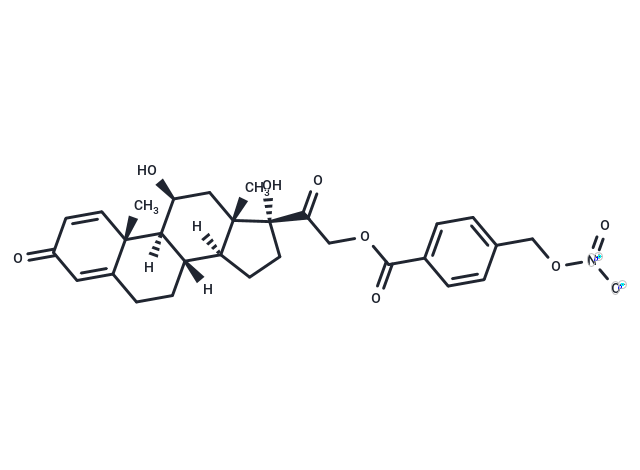
NO-prednisolone
CAS No. 327610-87-7
NO-prednisolone( —— )
Catalog No. M33613 CAS No. 327610-87-7
NO-prednisolone (NCX-1015) is a compound that effectively stimulates the production of IL-10 in vivo. It is a Prednisolone derivative that releases nitric oxide (NO).
Purity : >98% (HPLC)
 COA
Datasheet
HNMR
HPLC
MSDS
Handing Instructions
COA
Datasheet
HNMR
HPLC
MSDS
Handing Instructions
| Size | Price / USD | Stock | Quantity |
| 1 mL x 10 mM in DMSO | 125 | In Stock |


|
| 5MG | 105 | In Stock |
|
| 10MG | 164 | In Stock |
|
| 25MG | 297 | In Stock |
|
| 50MG | 414 | In Stock |
|
| 100MG | 581 | In Stock |
|
| 200MG | 768 | In Stock |
|
| 500MG | Get Quote | In Stock |
|
| 1G | Get Quote | In Stock |
|
Biological Information
-
Product NameNO-prednisolone
-
NoteResearch use only, not for human use.
-
Brief DescriptionNO-prednisolone (NCX-1015) is a compound that effectively stimulates the production of IL-10 in vivo. It is a Prednisolone derivative that releases nitric oxide (NO).
-
DescriptionNO-prednisolone is a nitric oxide (NO)-releasing derivative of Prednisolone.NO-prednisolone potently stimulates IL-10 production in vivo.
-
In VitroNO-prednisolone (NCX-1015), an NO-releasing derivative of Prednisolone, is demonstrated to be more effective than Prednisolone in reducing inflammation, inhibiting cytokine and chemokine generation, and up-regulating the expression of the steroid-sensitive cell-surface marker CD163 in human peripheral blood mononuclear cellsIncubation of PBMCs with NO-prednisolone (NCX-1015) and Prednisolone produces a concentration-dependent activation of CD163. NO-prednisolone is more potent than Prednisolone at inducing CD163 cell surface expression. The increased efficacy of NO-prednisolone, compared with the parent molecule Prednisolone, is also observed when assessing inhibition of LPS induced IL-1β production.
-
In VivoIn vivo treatment with NO-prednisolone (NCX-1015) potently stimulates IL-10 production, suggesting that the NO steroid induces a regulatory subset of T cells that negatively modulates intestinal inflammation. The two doses of NO-prednisolone tested, 0.5 and 5 mg/kg/day (equivalent to 0.33 and 3.3 mg/kg/day prednisone, respectively) effectively attenuates the severity of the wasting syndrome, ameliorates the colitis score, and reduces the colonic myeloperoxidase (MPO) activity. NO-prednisolone administration also reduces the colonic mRNA and protein content of tumor necrosis factor-α, IL-12, and IFN-γ. NO-prednisolone also reduces the expression of inducible NO synthase and cyclooxygenase-2 but in contrast does not inhibit colonic expression of IL-10 mRNA or protein. In fact, IL-10 expression is enhanced in mice treated with NO-prednisolone.
-
Synonyms——
-
PathwayApoptosis
-
TargetIL Receptor
-
RecptorIL Receptor
-
Research Area——
-
Indication——
Chemical Information
-
CAS Number327610-87-7
-
Formula Weight539.57
-
Molecular FormulaC29H33NO9
-
Purity>98% (HPLC)
-
SolubilityIn Vitro:?DMSO : 25 mg/mL (46.33 mM; Ultrasonic (<60°C)
-
SMILES[H][C@@]12CC[C@](O)(C(=O)COC(=O)c3ccc(CO[N+]([O-])=O)cc3)[C@@]1(C)C[C@H](O)[C@@]1([H])[C@@]2([H])CCC2=CC(=O)C=C[C@]12C
-
Chemical Name——
Shipping & Storage Information
-
Storage(-20℃)
-
ShippingWith Ice Pack
-
Stability≥ 2 years
Reference
1. Fiorucci S, et al. NCX-1015, a nitric-oxide derivative of prednisolone, enhances regulatory T cells in the lamina propria and protects against 2,4,6-trinitrobenzene sulfonic acid-induced colitis in mice. Proc Natl Acad Sci U S A. 2002 Nov 26;99(24):15770-?
molnova catalog



related products
-
Dupilumab
Dupilumab (REGN-668) is a fully human monoclonal antibody targeting the alpha subunit of the interleukin-4 receptor, thereby inhibiting IL-4 and IL-13 signaling.
-
NFAT Transcription F...
NFAT Transcription Factor Regulator-1 is an synthesis inhibitor of IL-2 (IC50 of 182 nM).
-
Procyanidin A2
Procyanidin A2 is a potential precursor of 5-(3',4'-dihydroxyphenyl)-γ-valerolactone, exhibits antioxidant, anti-inflammary, anti-hyperglycemia, and anti-type 2 diabetes activities.
