


 Cart
Cart
 sales@molnova.com



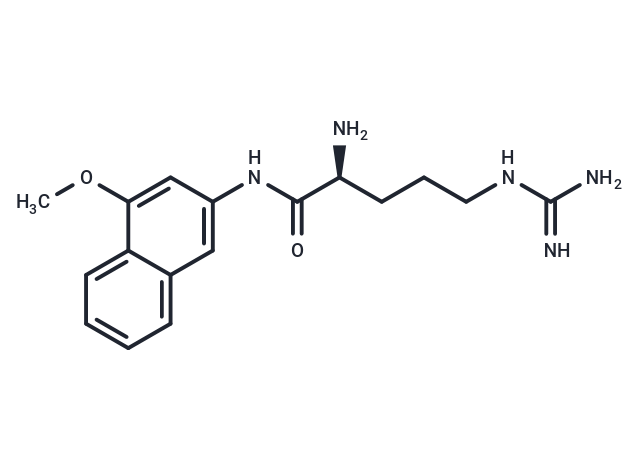
H-Arg-4MβNA
CAS No. 60285-94-1
H-Arg-4MβNA( —— )
Catalog No. M33603 CAS No. 60285-94-1
H-Arg-4MβNA (H-Arg-4MbNA) is a peptide that serves as a substrate for cathepsin H. The enzyme activity is often detected in gel electrophoresis.
Purity : >98% (HPLC)
 COA
Datasheet
HNMR
HPLC
MSDS
Handing Instructions
COA
Datasheet
HNMR
HPLC
MSDS
Handing Instructions
| Size | Price / USD | Stock | Quantity |
| 5MG | 28 | In Stock |


|
| 100MG | Get Quote | In Stock |
|
| 200MG | Get Quote | In Stock |
|
| 500MG | Get Quote | In Stock |
|
| 1G | Get Quote | In Stock |
|
Biological Information
-
Product NameH-Arg-4MβNA
-
NoteResearch use only, not for human use.
-
Brief DescriptionH-Arg-4MβNA (H-Arg-4MbNA) is a peptide that serves as a substrate for cathepsin H. The enzyme activity is often detected in gel electrophoresis.
-
DescriptionH-Arg-4MβNA is a substrate for cathepsin H, used for the detection of enzyme activity in gel electrophoresis.
-
In Vitro——
-
In Vivo——
-
Synonyms——
-
PathwayOthers
-
TargetOther Targets
-
RecptorOthers
-
Research Area——
-
Indication——
Chemical Information
-
CAS Number60285-94-1
-
Formula Weight329.4
-
Molecular FormulaC17H23N5O2
-
Purity>98% (HPLC)
-
SolubilityIn Vitro:?H2O : ≥ 125 mg/mL (379.48 mM)* "≥" means soluble, but saturation unknown.
-
SMILESCOc1cc(NC(=O)[C@@H](N)CCCNC(N)=N)cc2ccccc12
-
Chemical Name——
Shipping & Storage Information
-
Storage(-20℃)
-
ShippingWith Ice Pack
-
Stability≥ 2 years
Reference
1. Gossrau R. Histochemical and biochemical studies of dipeptidyl peptidase I (DPP I) in laboratory rodents. Acta Histochem. 1991;91(1):85-100.?
molnova catalog



related products
-
[D-Tyr6, b-Ala11, β-...
[D-Tyr6, b-Ala11, β-Phe13, Nle14]-Bombesin
-
Adoprazine
Adoprazine is a potential atypical antipsychotic bearing potent D2 receptor antagonist and 5-HT1A receptor agonist properties.
-
Manool
Manool, a diterpene from Salvia miltiorrhiza, showed antitumor activity in a mouse melanoma model.Manool caused cell cycle arrest in the G(2)/M phase of cancer cells, reducing the prevention of chromosomal damage and precancerous lesions.
