


 Cart
Cart
 sales@molnova.com



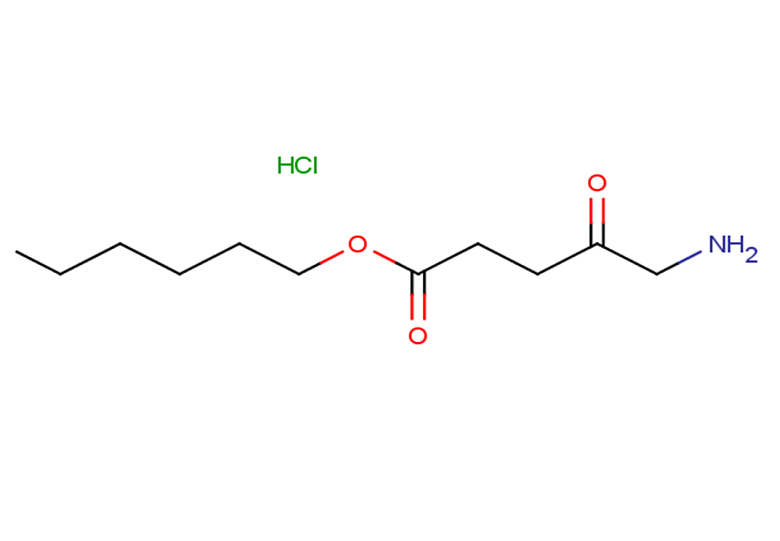
Hexaminolevulinate hydrochloride
CAS No. 140898-91-5
Hexaminolevulinate hydrochloride( Hexyl 5-aminolevulinate hydrochloride | P-1206 | 5-Aminolevulinic acid hexyl ester hydrochloride )
Catalog No. M23565 CAS No. 140898-91-5
Hexaminolevulinate hydrochloride has approved for cystoscopic detection of papillary bladder cancer and it also is a fluorescent agent.
Purity : >98% (HPLC)
 COA
Datasheet
HNMR
HPLC
MSDS
Handing Instructions
COA
Datasheet
HNMR
HPLC
MSDS
Handing Instructions
| Size | Price / USD | Stock | Quantity |
| 1 mL x 10 mM in DMSO | 28 | In Stock |


|
| 100MG | 27 | In Stock |
|
| 200MG | Get Quote | In Stock |
|
| 500MG | Get Quote | In Stock |
|
| 1G | Get Quote | In Stock |
|
Biological Information
-
Product NameHexaminolevulinate hydrochloride
-
NoteResearch use only, not for human use.
-
Brief DescriptionHexaminolevulinate hydrochloride has approved for cystoscopic detection of papillary bladder cancer and it also is a fluorescent agent.
-
DescriptionHexaminolevulinate hydrochloride has approved for cystoscopic detection of papillary bladder cancer and it also is a fluorescent agent.
-
In Vitro——
-
In Vivo——
-
SynonymsHexyl 5-aminolevulinate hydrochloride | P-1206 | 5-Aminolevulinic acid hexyl ester hydrochloride
-
PathwayOthers
-
TargetOther Targets
-
RecptorOthers
-
Research Area——
-
Indication——
Chemical Information
-
CAS Number140898-91-5
-
Formula Weight251.75
-
Molecular FormulaC11H22ClNO3
-
Purity>98% (HPLC)
-
SolubilityDMSO:41 mg/mL (162.86 mM)
-
SMILESCCCCCCOC(=O)CCC(=O)CN.Cl
-
Chemical Name——
Shipping & Storage Information
-
Storage(-20℃)
-
ShippingWith Ice Pack
-
Stability≥ 2 years
Reference
1.Rose JB, et al. Budget impact of incorporating one instillation of hexaminolevulinate hydrochloride blue-light cytoscopy in transurethral bladder tumour resection for patients with non-muscle-invasive bladder cancer in Sweden. BJU Int. 2015 Aug 25. doi: 1
molnova catalog



related products
-
Stachyose
Stachyose is a natual productit highly promotes proliferation of lactic acid bacteria (LAB) by inducing LAB to produce more α-galactosidase to hydrolyze stachyose.
-
2,3-dihydroxy-3-meth...
2,3-dihydroxy-3-methylbutanoic acid is a chemical compound.
-
Pseudoginsenoside F1...
Pseudoginsenoside-F11 is a component of Panax quinquefolium (American ginseng), can antagonize the learning and memory deficits induced by scopolamine, morphine, and methamphetamine in mice.
