


 Cart
Cart
 sales@molnova.com



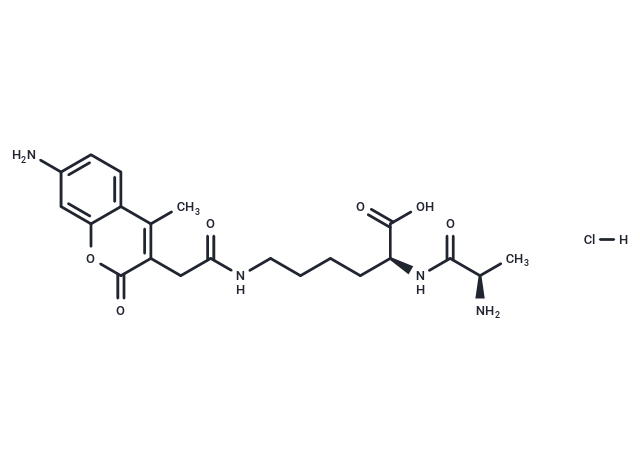
D-Ala-Lys-AMCA hydrochloride
CAS No. 2703746-41-0
D-Ala-Lys-AMCA hydrochloride( —— )
Catalog No. M33568 CAS No. 2703746-41-0
D-Ala-Lys-AMCA hydrochloride, a known substrate of proton-coupled oligopeptide transporter 1 (PEPT1), emits blue fluorescence and may be transported into Caco-2 cells and liver cancer cells.
Purity : >98% (HPLC)
 COA
Datasheet
HNMR
HPLC
MSDS
Handing Instructions
COA
Datasheet
HNMR
HPLC
MSDS
Handing Instructions
| Size | Price / USD | Stock | Quantity |
| 1 mL x 10 mM in DMSO | 307 | In Stock |


|
| 5MG | 297 | In Stock |
|
| 10MG | 511 | In Stock |
|
| 25MG | 829 | In Stock |
|
| 50MG | 1097 | In Stock |
|
| 100MG | Get Quote | In Stock |
|
| 200MG | Get Quote | In Stock |
|
| 500MG | Get Quote | In Stock |
|
| 1G | Get Quote | In Stock |
|
Biological Information
-
Product NameD-Ala-Lys-AMCA hydrochloride
-
NoteResearch use only, not for human use.
-
Brief DescriptionD-Ala-Lys-AMCA hydrochloride, a known substrate of proton-coupled oligopeptide transporter 1 (PEPT1), emits blue fluorescence and may be transported into Caco-2 cells and liver cancer cells.
-
DescriptionD-Ala-Lys-AMCA hydrochloride is a known proton-coupled oligopeptide transporter 1 (PEPT1) substrate that emits blue fluorescence. D-Ala-Lys-AMCA hydrochloride may be transported into liver cancer cells and Caco-2 cells based on fluorescence analysis. D-Ala-Lys-AMCA hydrochloride can be used for characterizing PEPT1-specific substrates or inhibitors.
-
In Vitro——
-
In Vivo——
-
Synonyms——
-
PathwayOthers
-
TargetOther Targets
-
RecptorOthers
-
Research Area——
-
Indication——
Chemical Information
-
CAS Number2703746-41-0
-
Formula Weight468.93
-
Molecular FormulaC21H29ClN4O6
-
Purity>98% (HPLC)
-
SolubilityIn Vitro:?H2O : 100 mg/mL (213.25 mM; Ultrasonic) DMSO : 100 mg/mL (213.25 mM; Ultrasonic )
-
SMILESNC1=CC=C(C(C)=C(CC(NCCCC[C@H](NC([C@@H](C)N)=O)C(O)=O)=O)C(O2)=O)C2=C1.[H]Cl
-
Chemical Name——
Shipping & Storage Information
-
Storage(-20℃)
-
ShippingWith Ice Pack
-
Stability≥ 2 years
Reference
1. Gong Y, et al. Specific expression of proton-coupled oligopeptide transporter 1 in primary hepatocarcinoma-anovel strategy for tumor-targeted therapy. Oncol Lett. 2017 Oct;14(4):4158-4166.?
molnova catalog



related products
-
ACTH (1-39), human
Adrenocorticotropic hormones (ACTH). ACTH stimulates the adrenal cortex and the secretion of glucocorticoids such as cortisol.
-
Etilefrine hydrochlo...
Etilefrine is a cardiac stimulant used as anantihypotensive.
-
Gentiournoside D
Gentiournoside D is a natural product from Gentiana urnula.
