


 Cart
Cart
 sales@molnova.com



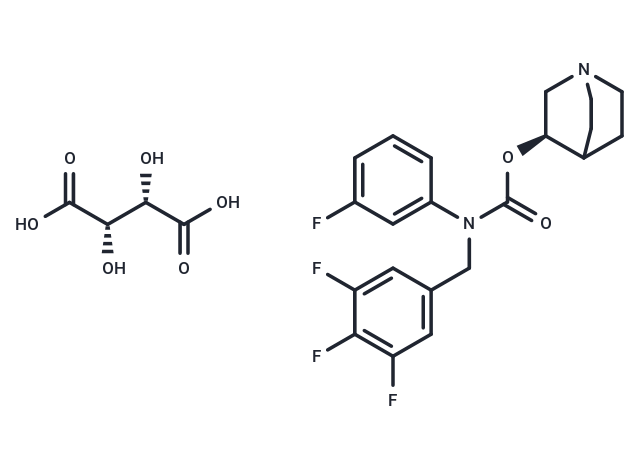
Tarafenacin D-tartrate
CAS No. 1159101-48-0
Tarafenacin D-tartrate( —— )
Catalog No. M33507 CAS No. 1159101-48-0
Tarafenacin D-tartrate (SVT-40776 D-tartrate) is a selective and potent muscarinic acetylcholine M3 receptor antagonist used in the study of overactive bladder and bronchial disorders.
Purity : >98% (HPLC)
 COA
Datasheet
HNMR
HPLC
MSDS
Handing Instructions
COA
Datasheet
HNMR
HPLC
MSDS
Handing Instructions
| Size | Price / USD | Stock | Quantity |
| 1 mL x 10 mM in DMSO | 354 | Get Quote |


|
| 2MG | 121 | Get Quote |
|
| 5MG | 206 | Get Quote |
|
| 100MG | Get Quote | Get Quote |
|
| 200MG | Get Quote | Get Quote |
|
| 500MG | Get Quote | Get Quote |
|
| 1G | Get Quote | Get Quote |
|
Biological Information
-
Product NameTarafenacin D-tartrate
-
NoteResearch use only, not for human use.
-
Brief DescriptionTarafenacin D-tartrate (SVT-40776 D-tartrate) is a selective and potent muscarinic acetylcholine M3 receptor antagonist used in the study of overactive bladder and bronchial disorders.
-
DescriptionTarafenacin D-tartrate (SVT-40776 D-tartrate) is a highly selective M3 muscarinic receptor antagonist (Ki= 0.19 nM), ~200 fold selectivity over M2 receptor.IC50 value: 0.19 nM (Ki) Target: M3 muscarinic receptor in vitro: SVT-40776 is highly selective for M(3) over M(2) receptors (Ki = 0.19 nmol.L(-1) for M(3) receptor affinity). SVT-40776 was the most potent in inhibiting carbachol-induced bladder contractions of the anti-cholinergic agents tested, without affecting atrial contractions over the same range of concentrations. SVT-40776 exhibited the highest urinary versus cardiac selectivity (199-fold) . SVT-40776 has a much higher binding affinity (K(d) = 0.4 nM) to M5 mAChR than that of solifenacin (K(d) = 31 nM) with the same reeptor. The calculated binding free energy change (-2.3 ± 0.3 kcal/mol) from solifenacin to SVT-40776 is in good agreement with the experimentally derived binding free energy change (-2.58 kcal/mol), suggesting that our modeled M5 mAChR structure and its complexes with the antagonists are reliable .in vivo: In the guinea pig in vivo model, SVT-40776 inhibited 25% of spontaneous bladder contractions at a very low dose (6.97 microg.kg(-1) i.v), without affecting arterial blood pressure .
-
In Vitro——
-
In Vivo——
-
Synonyms——
-
PathwayCell Cycle/DNA Damage
-
TargetAChR
-
RecptorAChR
-
Research Area——
-
Indication——
Chemical Information
-
CAS Number1159101-48-0
-
Formula Weight558.48
-
Molecular FormulaC25H26F4N2O8
-
Purity>98% (HPLC)
-
SolubilityIn Vitro:?DMSO : ≥ 100 mg/mL (179.06 mM )
-
SMILESO[C@@H]([C@H](O)C(O)=O)C(O)=O.Fc1cccc(c1)N(Cc1cc(F)c(F)c(F)c1)C(=O)O[C@H]1CN2CCC1CC2
-
Chemical Name——
Shipping & Storage Information
-
Storage(-20℃)
-
ShippingWith Ice Pack
-
Stability≥ 2 years
Reference
1. Salcedo C, et al. In vivo and in vitro pharmacological characterization of SVT-40776, a novel M3 muscarinic receptor antagonist, for the treatment of overactive bladder. Br J Pharmacol. 2009 Mar;156(5):807-17.?
molnova catalog



related products
-
Nitrocaramiphen hydr...
Nitrocaramiphen hydrochloride is a selective M1 muscarinic antagonist and inhibits binding to sigma sites in brain.
-
SCH 57790
SCH 57790 is a novel and selective muscarinic M(2) receptor antagonist that releases acetylcholine and enhances cognition in experimental animals for the treatment of Alzheimer's disease.
-
Pimethixene maleate
Pimethixene maleate (Pimetixene maleate) is a potent 5-HT2B receptor antagonist with sedative and antitussive activity.
