


 Cart
Cart
 sales@molnova.com



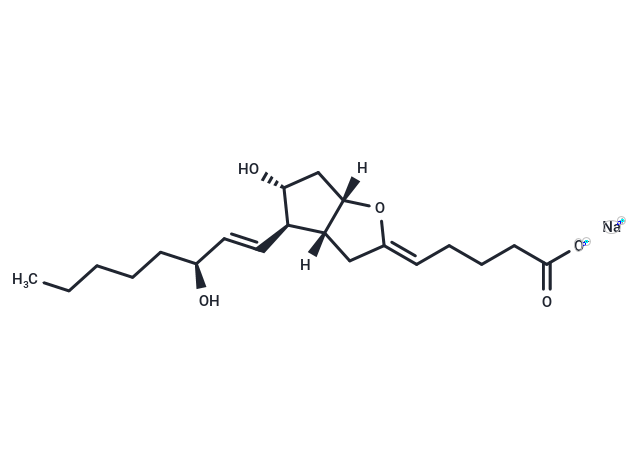
Epoprostenol sodium
CAS No. 61849-14-7
Epoprostenol sodium( —— )
Catalog No. M33350 CAS No. 61849-14-7
Epoprostenol sodium (Prostaglandin I2 sodium salt) is a short-acting vasodilator, a synthetic prostacyclin, and can be used to study pulmonary hypertension and congestive heart failure.
Purity : >98% (HPLC)
 COA
Datasheet
HNMR
HPLC
MSDS
Handing Instructions
COA
Datasheet
HNMR
HPLC
MSDS
Handing Instructions
| Size | Price / USD | Stock | Quantity |
| 2MG | 278 | Get Quote |


|
| 5MG | 753 | Get Quote |
|
| 10MG | 1359 | Get Quote |
|
| 25MG | 3082 | Get Quote |
|
| 100MG | Get Quote | Get Quote |
|
| 200MG | Get Quote | Get Quote |
|
| 500MG | Get Quote | Get Quote |
|
| 1G | Get Quote | Get Quote |
|
Biological Information
-
Product NameEpoprostenol sodium
-
NoteResearch use only, not for human use.
-
Brief DescriptionEpoprostenol sodium (Prostaglandin I2 sodium salt) is a short-acting vasodilator, a synthetic prostacyclin, and can be used to study pulmonary hypertension and congestive heart failure.
-
DescriptionEpoprostenol (sodium) (Standard) is the analytical standard of Epoprostenol (sodium). This product is intended for research and analytical applications. Epoprostenol sodium (Prostaglandin I2 (sodium salt)), the synthetic form of the natural prostaglandin derivative prostacyclin (prostaglandin I2), is registered worldwide for the treatment of Pulmonary arterial hypertension (PAH). Epoprostenol sodium is used in pulmonary hypertension and transplantation as a potent inhibitor of platelet aggregation.
-
In Vitro——
-
In Vivo——
-
Synonyms——
-
PathwayProteasome/Ubiquitin
-
TargetEndogenous Metabolite
-
RecptorEndogenous Metabolite
-
Research Area——
-
Indication——
Chemical Information
-
CAS Number61849-14-7
-
Formula Weight374.45
-
Molecular FormulaC20H31NaO5
-
Purity>98% (HPLC)
-
Solubility——
-
SMILESCCCCC[C@H](O)/C=C/[C@@H]1[C@]2([H])[C@@](C[C@H]1O)([H])O/C(C2)=C\CCCC([O-])=O.[Na+]
-
Chemical Name——
Shipping & Storage Information
-
Storage(-20℃)
-
ShippingWith Ice Pack
-
Stability≥ 2 years
Reference
molnova catalog



related products
-
Phosphorylcholine B
Phosphorylcholine is widely present in the biological world, which is a phospholipid present in the eukaryotic biofilm, and also in the symbiotic bacteria or pathogens associated with eukaryotes.
-
Zinc Protoporphyrin
Zinc Protoporphyrin is an orally active and competitive inhibitor of heme oxygenase-1 (HO-1) and markedly attenuates the protective effects of Phloroglucinol (PG) against H2O2, and has anti-cancer activity.
-
3-Methylxanthine
3-Methylxanthine, a xanthine derivative, is a cyclic guanosine monophosphate (GMP) inhibitor.
