


 Cart
Cart
 sales@molnova.com



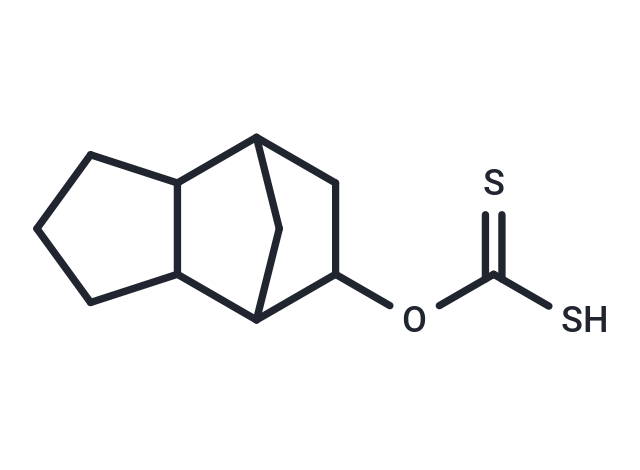
D609
CAS No. 83373-60-8
D609( —— )
Catalog No. M33331 CAS No. 83373-60-8
D609 (Tricyclodecan-9-yl-Xanthogenate) has a wide range of biological activities including antioxidant, antiapoptotic, anticholinergic, antitumor, anti-inflammatory, antiviral, antiproliferative, and neuroprotective activities.
Purity : >98% (HPLC)
 COA
Datasheet
HNMR
HPLC
MSDS
Handing Instructions
COA
Datasheet
HNMR
HPLC
MSDS
Handing Instructions
| Size | Price / USD | Stock | Quantity |
| 1 mL x 10 mM in DMSO | 56 | In Stock |


|
| 5MG | 50 | In Stock |
|
| 10MG | 79 | In Stock |
|
| 25MG | 128 | In Stock |
|
| 50MG | 183 | In Stock |
|
| 100MG | 269 | In Stock |
|
| 200MG | Get Quote | In Stock |
|
| 500MG | Get Quote | In Stock |
|
| 1G | Get Quote | In Stock |
|
Biological Information
-
Product NameD609
-
NoteResearch use only, not for human use.
-
Brief DescriptionD609 (Tricyclodecan-9-yl-Xanthogenate) has a wide range of biological activities including antioxidant, antiapoptotic, anticholinergic, antitumor, anti-inflammatory, antiviral, antiproliferative, and neuroprotective activities.
-
DescriptionD609, an antitumoural xanthate, is a specific and competitive phosphatidyl choline-specific phospholipase C (PC-PLC) inhibitor with a Ki of 6.4 μM. D609 is an antioxidative protector and has antiviral and anti-inflammatory activity.
-
In VitroCell Proliferation AssayCell Line:RAW 264.7 macrophages, N9 and BV-2 microglia, and DITNC1 astrocytes,Concentration:100 μM Incubation Time:For 2 hoursResult:Significantly attenuated the proliferation of RAW 264.7 macrophages, N9 and BV-2 microglia, and DITNC1 astrocytes, without affecting cell viability.Apoptosis Analysis Cell Line:BV-2 cells Concentration:50, 100 and 200 μM Incubation Time:For 2 hours Result:Activated caspase-3 in a dose- and time-dependent manner. Cell Cycle Analysis Cell Line:BV-2 cells Concentration:100 μM Incubation Time:For 2 hours Result:Significantly inhibited BrdU incorporation in BV-2 microglia and caused accumulation of cells in G1 phase with decreased number of cells in the S phase.Western Blot Analysis Cell Line:BV-2 cells Concentration:100 μM Incubation Time:For 2 hours Result:Increased ceramide levels, up-regulated p21 expression and causes a decreased in phospho-Rb.
-
In VivoAnimal Model:26-week-old apoE?/? and C57BL/6 WT mice Dosage:2.5, 10 mg/kg Administration:IP; per day for 6 weeks Result:Inhibited the progression of preexisting atherosclerotic lesions in apoE?/? mice and changed the lesion composition into a more stable phenotype. Significantly decreased the aortic endothelial expression of the vascular cell adhesion molecule-1 and the intercellular adhesion molecule-1.
-
Synonyms——
-
PathwayApoptosis
-
TargetApoptosis
-
RecptorApoptosis | Antioxidant
-
Research Area——
-
Indication——
Chemical Information
-
CAS Number83373-60-8
-
Formula Weight266.46
-
Molecular FormulaC11H15KOS2
-
Purity>98% (HPLC)
-
SolubilityIn Vitro:?DMSO : 100 mg/mL (375.29 mM; Ultrasonic ) H2O : 2 mg/mL (7.51 mM; Ultrasonic)
-
SMILESSC(=S)OC1CC2CC1C1CCCC21
-
Chemical Name——
Shipping & Storage Information
-
Storage(-20℃)
-
ShippingWith Ice Pack
-
Stability≥ 2 years
Reference
1. E Amtmann, et al. The antiviral, antitumoural xanthate D609 is a competitive inhibitor of phosphatidylcholine-specific phospholipase C. Drugs Exp Clin Res. 1996;22(6):287-94.?
molnova catalog



related products
-
Ginsenoside F5
Ginsenoside F5 is a natural product from Panax ginseng C. A. Mey, remarkably inhibits the growth of HL-60 cells by the apoptosis pathway.
-
Elesclomol
Elesclomol (STA-4783) is a small-molecule oxidative stress inducer.
-
NS3694
NS3694 is an inhibitor of apoptosis and inhibits apoptosome formation and caspase activation.
