


 Cart
Cart
 sales@molnova.com



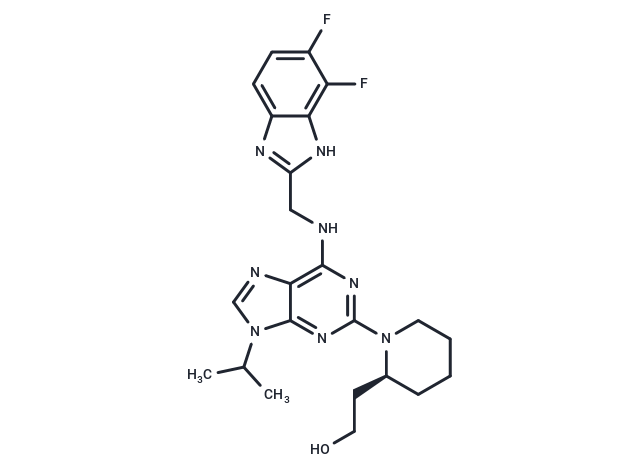
CDK12-IN-3
CAS No. 2220184-50-7
CDK12-IN-3( —— )
Catalog No. M33320 CAS No. 2220184-50-7
CDK12-IN-3 is a selective and potent CDK12 inhibitor with anti-tumor activity, which can be used to study malignant tumors.
Purity : >98% (HPLC)
 COA
Datasheet
HNMR
HPLC
MSDS
Handing Instructions
COA
Datasheet
HNMR
HPLC
MSDS
Handing Instructions
| Size | Price / USD | Stock | Quantity |
| 1 mL x 10 mM in DMSO | 345 | In Stock |


|
| 5MG | 312 | In Stock |
|
| 10MG | 511 | In Stock |
|
| 25MG | 1074 | In Stock |
|
| 50MG | 1758 | In Stock |
|
| 100MG | 2325 | In Stock |
|
| 200MG | Get Quote | In Stock |
|
| 500MG | Get Quote | In Stock |
|
| 1G | Get Quote | In Stock |
|
Biological Information
-
Product NameCDK12-IN-3
-
NoteResearch use only, not for human use.
-
Brief DescriptionCDK12-IN-3 is a selective and potent CDK12 inhibitor with anti-tumor activity, which can be used to study malignant tumors.
-
DescriptionCDK12-IN-3 is a potent and selective CDK12 inhibitor with an IC50 of 491 nM in enzymatic assay.
-
In Vitro——
-
In Vivo——
-
Synonyms——
-
PathwayCell Cycle/DNA Damage
-
TargetCDK
-
RecptorCDK
-
Research Area——
-
Indication——
Chemical Information
-
CAS Number2220184-50-7
-
Formula Weight470.52
-
Molecular FormulaC23H28F2N8O
-
Purity>98% (HPLC)
-
SolubilityIn Vitro:?DMSO : 250 mg/mL (531.33 mM; Ultrasonic )
-
SMILESCC(C)n1cnc2c(NCc3nc4ccc(F)c(F)c4[nH]3)nc(nc12)N1CCCC[C@H]1CCO
-
Chemical Name——
Shipping & Storage Information
-
Storage(-20℃)
-
ShippingWith Ice Pack
-
Stability≥ 2 years
Reference
1. Johannes JW, et al. Structure-Based Design of Selective Noncovalent CDK12 Inhibitors. ChemMedChem. 2018 Feb 6;13(3):231-235.?
molnova catalog



related products
-
CDK-IN-10
CDK-IN-10 is a cell cycle protein-dependent kinase (CDK) inhibitor with potential anticancer activity for cancer research.
-
WAY-322243
WAY-322243 has antibacterial and anti-inflammatory activity and has an inhibitory effect on CLK-1, which can be used to study Alzheimer's disease.
-
AT-7519 trifluoroace...
A potent CDK2 inhibitor with IC50 of 47 nM; also inhibits CDK1/4/5 with IC50 of 190/67/18 nM and shows selectivity over some kinases (Aurora A, IR kinase, MEK, PDK1, c-Abl, IC50>10 uM).
