


 Cart
Cart
 sales@molnova.com



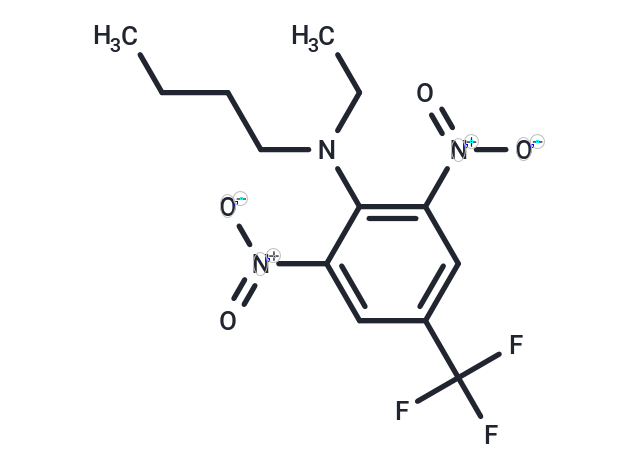
Benfluralin
CAS No. 1861-40-1
Benfluralin( —— )
Catalog No. M33286 CAS No. 1861-40-1
Benfluralin, a pre-emergence herbicide and agrochemical, is utilized for controlling grass and various weed species in both food and non-food crop applications.
Purity : >98% (HPLC)
 COA
Datasheet
HNMR
HPLC
MSDS
Handing Instructions
COA
Datasheet
HNMR
HPLC
MSDS
Handing Instructions
| Size | Price / USD | Stock | Quantity |
| 25MG | 28 | In Stock |


|
| 100MG | Get Quote | In Stock |
|
| 200MG | Get Quote | In Stock |
|
| 500MG | Get Quote | In Stock |
|
| 1G | Get Quote | In Stock |
|
Biological Information
-
Product NameBenfluralin
-
NoteResearch use only, not for human use.
-
Brief DescriptionBenfluralin, a pre-emergence herbicide and agrochemical, is utilized for controlling grass and various weed species in both food and non-food crop applications.
-
DescriptionBenfluralin is a kind of herbicide and an agrochemical which can be used as a pre-emergence herbicide used for the control of grass and other weeds in a range of food and non-food crops.
-
In Vitro——
-
In Vivo——
-
Synonyms——
-
PathwayOthers
-
TargetOther Targets
-
RecptorOthers
-
Research Area——
-
Indication——
Chemical Information
-
CAS Number1861-40-1
-
Formula Weight335.28
-
Molecular FormulaC13H16F3N3O4
-
Purity>98% (HPLC)
-
SolubilityIn Vitro:?DMSO : 150 mg/mL (447.39 mM; Ultrasonic )
-
SMILESCCCCN(CC)c1c(cc(cc1[N+]([O-])=O)C(F)(F)F)[N+]([O-])=O
-
Chemical Name——
Shipping & Storage Information
-
Storage(-20℃)
-
ShippingWith Ice Pack
-
Stability≥ 2 years
Reference
molnova catalog



related products
-
Tectorigenin-7-O-bet...
The roots of Pueraria lobata.
-
Carnosol
Carnosol has anti-oxidative, anti-inflammatory, antiproliferative and apoptosis inducing properties.
-
Butylparaben
Butylparaben is a Standardized Chemical Allergen.
