


 Cart
Cart
 sales@molnova.com



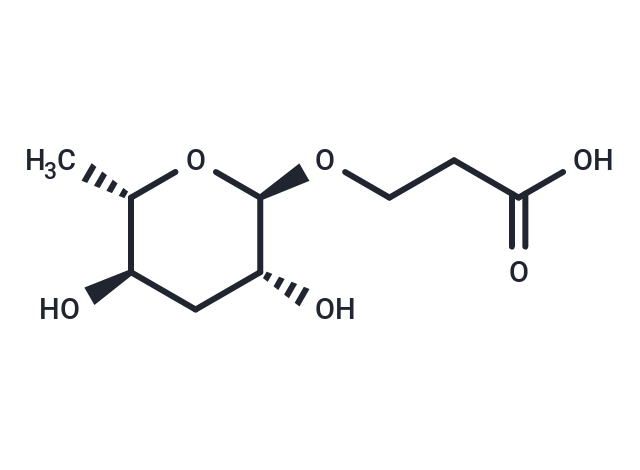
Ascr#5
CAS No. 1086696-26-5
Ascr#5( —— )
Catalog No. M33201 CAS No. 1086696-26-5
Ascr#5 (asc-ωC3) is a highly conserved ascoside analogue in Cryptococcus hidradii that modulates a variety of responses in Cryptococcus hidradii.
Purity : >98% (HPLC)
 COA
Datasheet
HNMR
HPLC
MSDS
Handing Instructions
COA
Datasheet
HNMR
HPLC
MSDS
Handing Instructions
| Size | Price / USD | Stock | Quantity |
| 2MG | 454 | Get Quote |


|
| 100MG | Get Quote | Get Quote |
|
| 200MG | Get Quote | Get Quote |
|
| 500MG | Get Quote | Get Quote |
|
| 1G | Get Quote | Get Quote |
|
Biological Information
-
Product NameAscr#5
-
NoteResearch use only, not for human use.
-
Brief DescriptionAscr#5 (asc-ωC3) is a highly conserved ascoside analogue in Cryptococcus hidradii that modulates a variety of responses in Cryptococcus hidradii.
-
DescriptionAscr#5 is a highly conserved ascaroside isolated from Caenorhabditis elegans.
-
In Vitro——
-
In Vivo——
-
Synonyms——
-
PathwayOthers
-
TargetOther Targets
-
RecptorOthers
-
Research Area——
-
Indication——
Chemical Information
-
CAS Number1086696-26-5
-
Formula Weight220.22
-
Molecular FormulaC9H16O6
-
Purity>98% (HPLC)
-
SolubilityIn Vitro:?DMSO : 100 mg/mL (454.09 mM; Ultrasonic )
-
SMILESC[C@@H]1O[C@@H](OCCC(O)=O)[C@H](O)C[C@H]1O
-
Chemical Name——
Shipping & Storage Information
-
Storage(-20℃)
-
ShippingWith Ice Pack
-
Stability≥ 2 years
Reference
1. Dong C, et al. Comparative Ascaroside Profiling of Caenorhabditis Exometabolomes Reveals Species-Specific (ω) and (ω - 2)-Hydroxylation Downstream of Peroxisomal β-Oxidation. J Org Chem. 2018 Jul 6;83(13):7109-7120.?
molnova catalog



related products
-
Fmoc-NH-PEG12-CH2CH2...
Fmoc-NH-PEG12-CH2CH2COOH is a PEG-based PROTAC linker that can be used in the synthesis of PROTACs.
-
Lanreotide acetate
Lanreotide acetate (BIM 23014 acetate) has been used as an inhibitor to test the variability of h2s regulation in wild-type mice with growth hormone/thyroid hormone signal transduction.
-
MMP Substrate I, flu...
Dnp-PLGLWAr-NH2 is a synthetic collagenase/gelatinase substrate. Dnp-PLGLWAR-NH2 can be used to quantify total MMP activity in APMA-activated conditioned medium samples.
