


 Cart
Cart
 sales@molnova.com



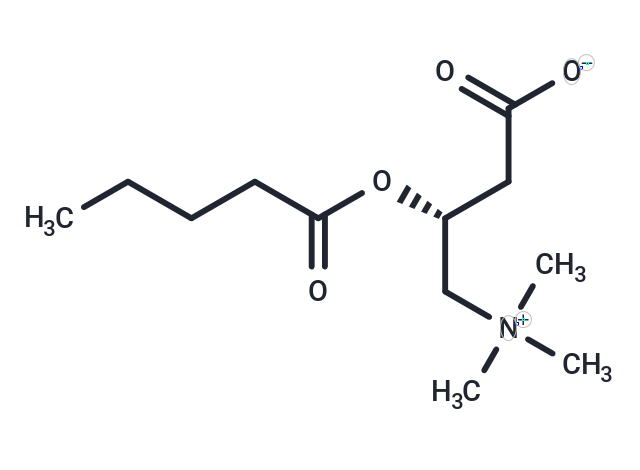
Valerylcarnitine
CAS No. 40225-14-7
Valerylcarnitine( —— )
Catalog No. M33161 CAS No. 40225-14-7
Valerylcarnitine (VALERYL-L-CARNITINE) is a short-chain fatty acid used in the study of type 2 diabetes.
Purity : >98% (HPLC)
 COA
Datasheet
HNMR
HPLC
MSDS
Handing Instructions
COA
Datasheet
HNMR
HPLC
MSDS
Handing Instructions
| Size | Price / USD | Stock | Quantity |
| 1 mL x 10 mM in DMSO | 93 | In Stock |


|
| 5MG | 78 | In Stock |
|
| 10MG | 112 | In Stock |
|
| 25MG | 183 | In Stock |
|
| 50MG | 266 | In Stock |
|
| 100MG | 393 | In Stock |
|
| 200MG | Get Quote | In Stock |
|
| 500MG | Get Quote | In Stock |
|
| 1G | Get Quote | In Stock |
|
Biological Information
-
Product NameValerylcarnitine
-
NoteResearch use only, not for human use.
-
Brief DescriptionValerylcarnitine (VALERYL-L-CARNITINE) is a short-chain fatty acid used in the study of type 2 diabetes.
-
DescriptionValerylcarnitine is an endogenous metabolite, belonging to the short-chain acylcarnitines.
-
In Vitro——
-
In Vivo——
-
Synonyms——
-
PathwayProteasome/Ubiquitin
-
TargetEndogenous Metabolite
-
RecptorEndogenous Metabolite
-
Research Area——
-
Indication——
Chemical Information
-
CAS Number40225-14-7
-
Formula Weight245.32
-
Molecular FormulaC12H23NO4
-
Purity>98% (HPLC)
-
SolubilityIn Vitro:?H2O : 250 mg/mL (1019.08 mM; Ultrasonic) DMSO : 33.33 mg/mL (135.86 mM; Ultrasonic )
-
SMILESCCCCC(=O)O[C@H](CC([O-])=O)C[N+](C)(C)C
-
Chemical Name——
Shipping & Storage Information
-
Storage(-20℃)
-
ShippingWith Ice Pack
-
Stability≥ 2 years
Reference
1. Pannkuk EL, et al. Targeted Metabolomics of Nonhuman Primate Serum after Exposure to Ionizing Radiation: Potential Tools for High-throughput Biodosimetry. RSC Adv. 2016;6(56):51192-51202.?
molnova catalog



related products
-
Angiotensin III, hum...
Angiotensin III is an agonist of angiotensin 1 (AT1) and AT2 receptor.
-
Ursocholic acid
Ursocholic acid a bile acid found predominantly in bile of mammals.
-
Diphenyl disulfide
Diphenyl disulfide (Phenyl disulfide) shows anticancer activity in breast cancer cell lines.Diphenyl disulfide induces and enhances apoptosis in breast cancer cells through Bax protein hydrolysis activation and concomitant autophagy.
