


 Cart
Cart
 sales@molnova.com



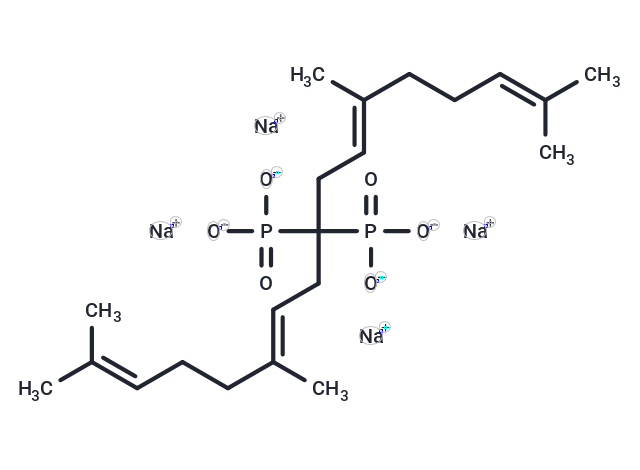
Digeranyl bisphosphonate
CAS No. 878143-03-4
Digeranyl bisphosphonate( —— )
Catalog No. M33063 CAS No. 878143-03-4
Digeranyl bisphosphonate (DGBP) is a potent geranylgeranyl pyrophosphate (GGPP) synthase inhibitor that impedes the geranyl pyrophosphorylation of Rac1 and induces autophagy without causing apoptosis.
Purity : >98% (HPLC)
 COA
Datasheet
HNMR
HPLC
MSDS
Handing Instructions
COA
Datasheet
HNMR
HPLC
MSDS
Handing Instructions
| Size | Price / USD | Stock | Quantity |
| 5MG | 503 | In Stock |


|
| 10MG | 806 | In Stock |
|
| 25MG | 1444 | In Stock |
|
| 50MG | 1841 | In Stock |
|
| 100MG | 2325 | In Stock |
|
| 200MG | Get Quote | In Stock |
|
| 500MG | Get Quote | In Stock |
|
| 1G | Get Quote | In Stock |
|
Biological Information
-
Product NameDigeranyl bisphosphonate
-
NoteResearch use only, not for human use.
-
Brief DescriptionDigeranyl bisphosphonate (DGBP) is a potent geranylgeranyl pyrophosphate (GGPP) synthase inhibitor that impedes the geranyl pyrophosphorylation of Rac1 and induces autophagy without causing apoptosis.
-
DescriptionDigeranyl bisphosphonate (DGBP) is a potent geranylgeranylpyrophosphate (GGPP) synthase inhibitor, which inhibits geranylgeranylation of Rac1.
-
In VitroDigeranyl bisphosphonate (DGBP) impairs geranylgeranylation. To examine if Digeranyl bisphosphonate modulates Rac1 activity, cells are exposed to vehicle or Digeranyl bisphosphonate. Rac1 activation increases significantly after chrysotile exposure, whereas the activity in Digeranyl bisphosphonate -treated cells is reduced to control levels. Digeranyl bisphosphonate also decreases H2O2 generation in chrysotile-exposed macrophages.
-
In VivoTo further evaluate the effect of Digeranyl bisphosphonate (DGBP; 0.2 mg/kg/day) in protecting mice from chrysotile-induced pulmonary fibrosis, the mice are administered vehicle or Digeranyl bisphosphonate subcutaneously in osmotic pumps, and exposed to saline or chrysotile the following day. Mice exposed to saline have normal lung architecture with vehicle and Digeranyl bisphosphonate treatment. Chrysotile-exposed mice that receive vehicle have significant architectural changes in their lung parenchyma and large amounts of collagen deposition, whereas the lungs of the Digeranyl bisphosphonate -treated mice are essentially normal. To investigate the effect of Digeranyl bisphosphonate in Bleomycin-induced fibrosis, osmotic pumps containing either vehicle or Digeranyl bisphosphonate are implanted subcutaneously in WT mice. Mice are exposed to saline or Bleomycin the following day. Digeranyl bisphophonate (0.2 mg/kg/day)-treated mice show significantly less hydroxyproline compared to vehicle-treated mice exposed to Bleomycin.
-
Synonyms——
-
PathwayCell Cycle/DNA Damage
-
TargetRho
-
RecptorRho | Ras
-
Research Area——
-
Indication——
Chemical Information
-
CAS Number878143-03-4
-
Formula Weight536.4
-
Molecular FormulaC21H34Na4O6P2
-
Purity>98% (HPLC)
-
SolubilityIn Vitro:?DMSO : 2 mg/mL (3.73 mM; Ultrasonic ) H2O : 2 mg/mL (3.73 mM; Ultrasonic)
-
SMILESC/C(C)=C\CC/C(C)=C/CC(P([O-])([O-])=O)(P([O-])([O-])=O)C/C=C(C)/CC/C=C(C)\C.[Na+].[Na+].[Na+].[Na+]
-
Chemical Name——
Shipping & Storage Information
-
Storage(-20℃)
-
ShippingWith Ice Pack
-
Stability≥ 2 years
Reference
1. Osborn-Heaford HL, et al. Targeting the isoprenoid pathway to abrogate progression of pulmonary fibrosis. Free Radic Biol Med. 2015 Sep;86:47-56.?
molnova catalog



related products
-
CCG-257081
CCG-257081 (MRTF/SRF-IN-1) is an inhibitor of cardiac myosin-related transcription factor and serum response factor (MRTF/SRF) that acts by inhibiting the Rho/MRTF/SRF pathway.CCG-257081 has shown efficacy in preventing bleomycin-induced fibrosis in several mouse models.
-
CCG-100602
CCG-100602 inhibits RhoA/C-mediated, SRF-driven luciferase expression in PC-3 prostate cancer cells (IC50 :9.8 μM).
-
(E/Z)-ZINC09659342
(E/Z)-ZINC09659342 is an inhibitor of Lbc-Rho A interaction.
