


 Cart
Cart
 sales@molnova.com



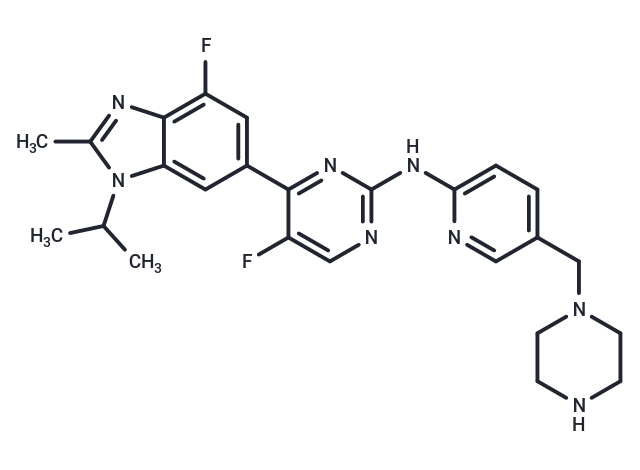
LSN2839567
CAS No. 1231930-57-6
LSN2839567( —— )
Catalog No. M32766 CAS No. 1231930-57-6
LSN2839567 (Abemaciclib metabolite M2) is the active metabolite of Abemaciclib, a potent CDK4 and CDK6 inhibitor (IC50s: 1-3 nM) with anticancer activity.
Purity : >98% (HPLC)
 COA
Datasheet
HNMR
HPLC
MSDS
Handing Instructions
COA
Datasheet
HNMR
HPLC
MSDS
Handing Instructions
| Size | Price / USD | Stock | Quantity |
| 5MG | 117 | In Stock |


|
| 10MG | 188 | In Stock |
|
| 25MG | 417 | In Stock |
|
| 50MG | 601 | In Stock |
|
| 100MG | Get Quote | In Stock |
|
| 200MG | Get Quote | In Stock |
|
| 500MG | Get Quote | In Stock |
|
| 1G | Get Quote | In Stock |
|
Biological Information
-
Product NameLSN2839567
-
NoteResearch use only, not for human use.
-
Brief DescriptionLSN2839567 (Abemaciclib metabolite M2) is the active metabolite of Abemaciclib, a potent CDK4 and CDK6 inhibitor (IC50s: 1-3 nM) with anticancer activity.
-
DescriptionAbemaciclib metabolite M2 (LSN2839567) is a metabolite of Abemaciclib, acts as a potent CDK4 and CDK6 inhibitor, with IC50s of 1.2 and 1.3 nM, respectively. Anti-cancer activity.
-
In Vitro——
-
In Vivo——
-
Synonyms——
-
PathwayCell Cycle/DNA Damage
-
TargetCDK
-
RecptorCDK
-
Research Area——
-
Indication——
Chemical Information
-
CAS Number1231930-57-6
-
Formula Weight478.54
-
Molecular FormulaC25H28F2N8
-
Purity>98% (HPLC)
-
SolubilityIn Vitro:?DMSO : 2 mg/mL (4.18 mM; Ultrasonic )
-
SMILESCC(C)n1c(C)nc2c(F)cc(cc12)-c1nc(Nc2ccc(CN3CCNCC3)cn2)ncc1F
-
Chemical Name——
Shipping & Storage Information
-
Storage(-20℃)
-
ShippingWith Ice Pack
-
Stability≥ 2 years
Reference
1. Teresa Burke, et al. Abstract 2830: The major human metabolites of abemaciclib are inhibitors of CDK4 and CDK6. Cancer Research. July 2016, 76 (14).
molnova catalog



related products
-
CLK1/2-IN-3
CLK1/2-IN-3 (Cpd-3) is a potent and selective CLK1 and CLK2 inhibitor with antiproliferative activity and inhibits the activities of CLK1, CLK2, SRPK1, SRPK2, and SRPK3.CLK1/2-IN-3 induces nuclear speckle enlargement.
-
XPW1
XPW1 is a new potent and selective CDK9 inhibitor with antitumour activity that transcriptionally inhibits the DNA repair process in ccRCC cells.XPW1 can be used to study clear cell renal cell carcinoma.
-
Roniciclib
A novel potent, orally active, pan-CDK inhibitor with IC50 of 7/9/11 nM for CDK1/2/4 respectively, inhibits transcriptional CDK9/7 with IC50 of 5-25 nM.
