


 Cart
Cart
 sales@molnova.com


 Home -
Products -
Others -
Other Targets -
3-(2-Hydroxy-4,6-dimethoxyphenyl)-1-(4-hydroxyphenyl)-1-propanone
Home -
Products -
Others -
Other Targets -
3-(2-Hydroxy-4,6-dimethoxyphenyl)-1-(4-hydroxyphenyl)-1-propanone
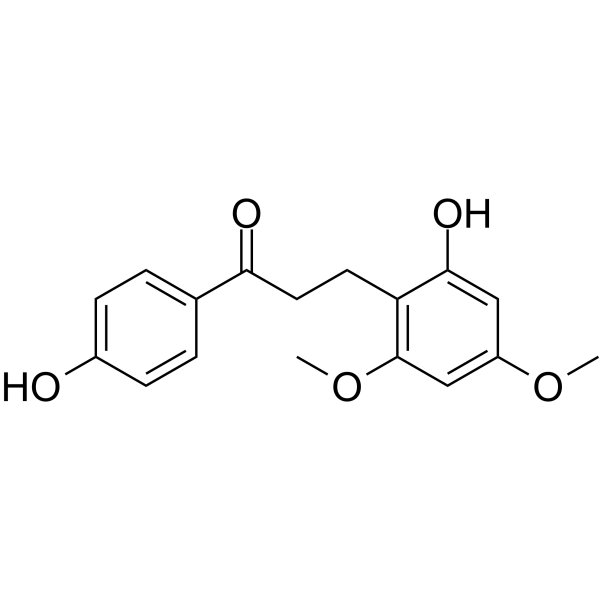
3-(2-Hydroxy-4,6-dimethoxyphenyl)-1-(4-hydroxyphenyl)-1-propanone
CAS No. 151752-07-7
3-(2-Hydroxy-4,6-dimethoxyphenyl)-1-(4-hydroxyphenyl)-1-propanone( —— )
Catalog No. M32255 CAS No. 151752-07-7
4',2-Dihydroxy-4,6-dimethoxydihydrochalcone, an estrogen agonist, exhibits a significant binding affinity for the estrogen receptor in bovine uterine tissue, with an IC50 value of 15 μM.
Purity : >98% (HPLC)
 COA
Datasheet
HNMR
HPLC
MSDS
Handing Instructions
COA
Datasheet
HNMR
HPLC
MSDS
Handing Instructions
| Size | Price / USD | Stock | Quantity |
| 5MG | 551 | In Stock |


|
| 50MG | Get Quote | In Stock |
|
| 100MG | Get Quote | In Stock |
|
| 200MG | Get Quote | In Stock |
|
| 500MG | Get Quote | In Stock |
|
| 1G | Get Quote | In Stock |
|
Biological Information
-
Product Name3-(2-Hydroxy-4,6-dimethoxyphenyl)-1-(4-hydroxyphenyl)-1-propanone
-
NoteResearch use only, not for human use.
-
Brief Description4',2-Dihydroxy-4,6-dimethoxydihydrochalcone, an estrogen agonist, exhibits a significant binding affinity for the estrogen receptor in bovine uterine tissue, with an IC50 value of 15 μM.
-
Description4',2-Dihydroxy-4,6-dimethoxydihydrochalcone, an estrogen agonist, exhibits a significant binding affinity for the estrogen receptor in bovine uterine tissue, with an IC50 value of 15 μM.
-
In Vitro4',2-Dihydroxy-4,6-dimethoxydihydrochalcone stimulates the MCF-7 cell proliferation in a concentration dependent manner between 10 nM and 10 μM.
-
In Vivo——
-
Synonyms——
-
PathwayOthers
-
TargetOther Targets
-
Recptor——
-
Research Area——
-
Indication——
Chemical Information
-
CAS Number151752-07-7
-
Formula Weight302.32
-
Molecular FormulaC17H18O5
-
Purity>98% (HPLC)
-
Solubility——
-
SMILES——
-
Chemical Name——
Shipping & Storage Information
-
Storage(-20℃)
-
ShippingWith Ice Pack
-
Stability≥ 2 years
Reference
molnova catalog



related products
-
PRX-08066 Maleic aci...
PRX-08066 Maleic acid is a selective 5-HT2B receptor antagonist with IC50 of 3.4 nM, prevents the severity of pulmonary arterial hypertension in the MCT rat model. Phase 2.
-
Praeruptorin E
Praeruptorin C and E can relax swine coronary artery and decrease contractility in guinea-pig left atria, these effects are similar in many respects to those displayed by drugs that have calcium entry blocking activity.
-
TB500
TB-500 is a synthesised peptide, essentially a short-chain version of the naturally occurring Thymosin Beta-4.
