


 Cart
Cart
 sales@molnova.com



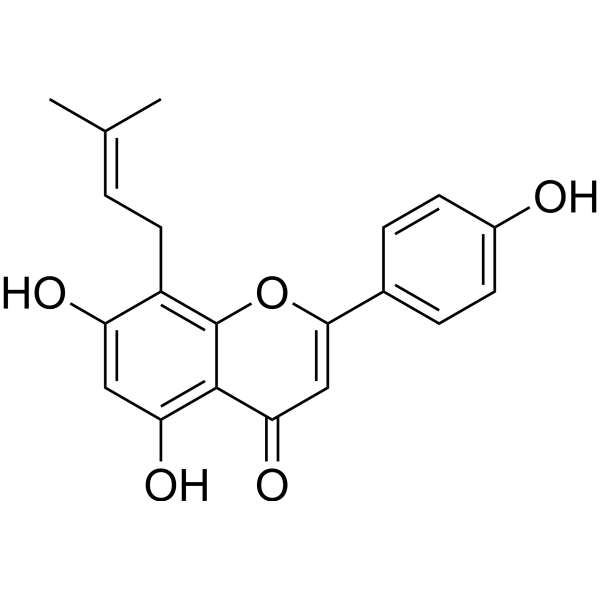
Licoflavone C
CAS No. 72357-31-4
Licoflavone C( —— )
Catalog No. M31245 CAS No. 72357-31-4
Licoflavone C has cytotoxic, and antioxidative effects, it has protective effect toward the chromosome damage induced by DAU or MMC in cultured human peripheral lymphocytes.
Purity : >98% (HPLC)
 COA
Datasheet
HNMR
HPLC
MSDS
Handing Instructions
COA
Datasheet
HNMR
HPLC
MSDS
Handing Instructions
| Size | Price / USD | Stock | Quantity |
| 5MG | 117 | In Stock |


|
| 10MG | 170 | In Stock |
|
| 100MG | Get Quote | In Stock |
|
| 200MG | Get Quote | In Stock |
|
| 500MG | Get Quote | In Stock |
|
| 1G | Get Quote | In Stock |
|
Biological Information
-
Product NameLicoflavone C
-
NoteResearch use only, not for human use.
-
Brief DescriptionLicoflavone C has cytotoxic, and antioxidative effects, it has protective effect toward the chromosome damage induced by DAU or MMC in cultured human peripheral lymphocytes.
-
DescriptionLicoflavone C has cytotoxic, and antioxidative effects, it has protective effect toward the chromosome damage induced by DAU or MMC in cultured human peripheral lymphocytes. Licoflavone C exhibits a dose-dependent antagonistic activity at concentrations up to 10-4 M, but stimulates α2-galactosidase expression at higher concentrations resulting in a U-shaped-like dose-response curve.
-
In Vitro——
-
In Vivo——
-
Synonyms——
-
PathwayOthers
-
TargetOther Targets
-
Recptor——
-
Research Area——
-
Indication——
Chemical Information
-
CAS Number72357-31-4
-
Formula Weight338.4
-
Molecular FormulaC20H18O5
-
Purity>98% (HPLC)
-
Solubility——
-
SMILES——
-
Chemical Name——
Shipping & Storage Information
-
Storage(-20℃)
-
ShippingWith Ice Pack
-
Stability≥ 2 years
Reference
molnova catalog



related products
-
Plantamajoside
Plantamajoside has anti-hepatotoxic, anti-inflammatory, antinociceptive activities, improving sexual function and antioxidant activity.
-
Quercetin 3-O-β-D-ga...
Quercetin 3-O-β-D-galactosyl-(1→2)-α-L-rhamnosyl-7-O-β-D-glucoside
-
13-Dimethyl-5-(2-pro...
13-Dimethyl-5-(2-propen-1-yl)-246(1H3H5H)-pyrimidinetrione is a reagent of research interest in the study alkene cyclization.
