


 Cart
Cart
 sales@molnova.com



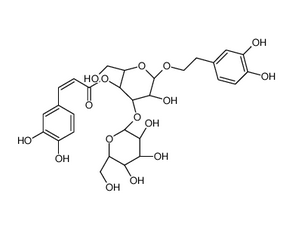
Plantamajoside
CAS No. 104777-68-6
Plantamajoside( Plantamajoside )
Catalog No. M17124 CAS No. 104777-68-6
Plantamajoside has anti-hepatotoxic, anti-inflammatory, antinociceptive activities, improving sexual function and antioxidant activity.
Purity : >98% (HPLC)
 COA
Datasheet
HNMR
HPLC
MSDS
Handing Instructions
COA
Datasheet
HNMR
HPLC
MSDS
Handing Instructions
| Size | Price / USD | Stock | Quantity |
| 1 mL x 10 mM in DMSO | 68 | In Stock |


|
| 2MG | 31 | In Stock |
|
| 5MG | 48 | In Stock |
|
| 10MG | 67 | In Stock |
|
| 25MG | 107 | In Stock |
|
| 50MG | 152 | In Stock |
|
| 100MG | 222 | In Stock |
|
| 200MG | 331 | In Stock |
|
| 500MG | Get Quote | In Stock |
|
| 1G | Get Quote | In Stock |
|
Biological Information
-
Product NamePlantamajoside
-
NoteResearch use only, not for human use.
-
Brief DescriptionPlantamajoside has anti-hepatotoxic, anti-inflammatory, antinociceptive activities, improving sexual function and antioxidant activity.
-
DescriptionPlantamajoside is an antioxidant that act by decreasing the ROS generation and lipid peroxidation.
-
In Vitro——
-
In Vivo——
-
SynonymsPlantamajoside
-
PathwayOthers
-
TargetOther Targets
-
RecptorOthers
-
Research AreaInflammation/Immunology
-
Indication——
Chemical Information
-
CAS Number104777-68-6
-
Formula Weight640.6
-
Molecular FormulaC29H36O16
-
Purity>98% (HPLC)
-
SolubilityIn Vitro:?DMSO : 100 mg/mL (156.11 mM)
-
SMILESC1=CC(=C(C=C1CCO[C@H]2[C@@H]([C@H]([C@@H]([C@H](O2)CO)OC(=O)/C=C/C3=CC(=C(C=C3)O)O)O[C@H]4[C@@H]([C@H]([C@@H]([C@H](O4)CO)O)O)O)O)O)O
-
Chemical Name(2R,3R,4R,5R,6R)-6-(3,4-dihydroxyphenethoxy)-5-hydroxy-2-(hydroxymethyl)-4-(((2S,3R,4S,5S,6R)-3,4,5-trihydroxy-6-(hydroxymethyl)tetrahydro-2H-pyran-2-yl)oxy)tetrahydro-2H-pyran-3-yl (E)-3-(3,4-dihydroxyphenyl)acrylate
Shipping & Storage Information
-
Storage(-20℃)
-
ShippingWith Ice Pack
-
Stability≥ 2 years
Reference
molnova catalog



related products
-
Ethyleneurea
2-Imidazolidinone is used as a formaldehyde scavenger and intermediate.
-
Adipokinetic Hormone...
Adipokinetic hormone Gryllus bimaculatus (Grybi-AKH) is an adipokinetic hormone that regulates energy homeostasis in insects by mobilizing lipid and carbohydrate from the fat body. Adipokinetic hormone Gryllus bimaculatus stimulates the locomotor activity of the two-spotted cricket. Adipokinetic hormone Gryllus bimaculatus can also be used in studies to regulate body weight, induce weight loss and alleviate glycogen storage disorders in humans.
-
1-Furfurylpyrrole
1-Furfurylpyrrole is a potential contributor of flavor and aroma to popcorn.
