


 Cart
Cart
 sales@molnova.com



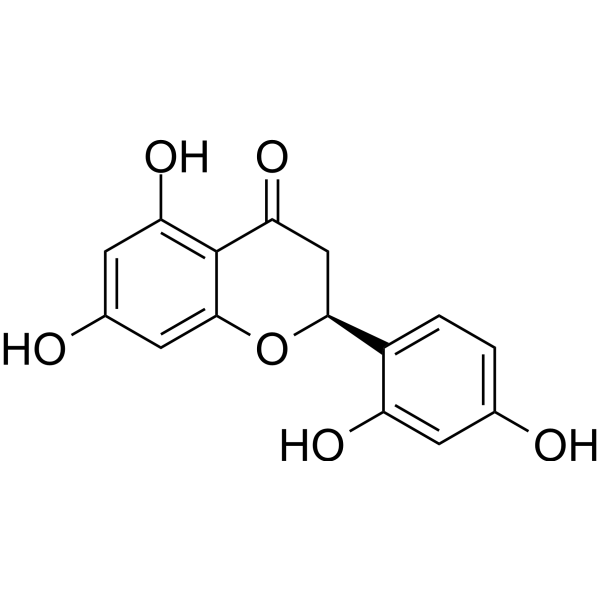
Steppogenin
CAS No. 56486-94-3
Steppogenin( —— )
Catalog No. M31003 CAS No. 56486-94-3
Steppogenin exhibits significant tyrosinase inhibition activity, ;it also shows strong mushroom tyrosinase inhibitory activity with IC(50) values lower than 50 microM, more potent than kojic acid (IC(50) = 71.6 microM), a well-known tyrosinase inhibitor.
Purity : >98% (HPLC)
 COA
Datasheet
HNMR
HPLC
MSDS
Handing Instructions
COA
Datasheet
HNMR
HPLC
MSDS
Handing Instructions
| Size | Price / USD | Stock | Quantity |
| 5MG | 495 | In Stock |


|
| 50MG | Get Quote | In Stock |
|
| 100MG | Get Quote | In Stock |
|
| 200MG | Get Quote | In Stock |
|
| 500MG | Get Quote | In Stock |
|
| 1G | Get Quote | In Stock |
|
Biological Information
-
Product NameSteppogenin
-
NoteResearch use only, not for human use.
-
Brief DescriptionSteppogenin exhibits significant tyrosinase inhibition activity, ;it also shows strong mushroom tyrosinase inhibitory activity with IC(50) values lower than 50 microM, more potent than kojic acid (IC(50) = 71.6 microM), a well-known tyrosinase inhibitor.
-
DescriptionSteppogenin exhibits significant tyrosinase inhibition activity, ;it also shows strong mushroom tyrosinase inhibitory activity with IC(50) values lower than 50 microM, more potent than kojic acid (IC(50) = 71.6 microM), a well-known tyrosinase inhibitor.
-
In VitroRT-PCRCell Line:A549 cells Concentration:0, 0.3, 1, 3 μM Incubation Time:6 h Result:Suppressed the mRNA expression of HIF-1α target genes (VEGF, GLUT1, CXCR4, and CA9) under hypoxic conditions.Western Blot Analysis Cell Line:HEK293T, A549, ARPE19 cells Concentration:0, 0.3, 1, 3 μM Incubation Time:16 h Result:Significantly suppressed HIF-1α protein levels in a dose-dependent manner. reduced nuclear expression of HIF-1α under hypoxic conditions. Inhibited protein levels of VEGF, CXCR4, and CA9 compared with the levels detected in the vehicle control group. Suppresseed VEGF-induced DLL4 protein expression.
-
In VivoPharmacokinetic Parameters of Steppogenin in male C57BL/6 J mice. Animal Model:C57BL/6 J mice (6-week-old, male, Lewis lung carcinoma (LLC) allograft tumor model)Dosage:2 mg/kg Administration:IP, once Result:Significantly suppressed tumor growth.Animal Model:C57BL/6 J mice (6-week-old, male, Lewis lung carcinoma (LLC) allograft tumor model)Dosage:2 mg/kg Administration:IP, once (Pharmacokinetic Analysis)Result:Showed the highest distribution to the liver and spleen (25.5-fold and 9.74-fold AUC ratio, respectively) with significantly higher T1/2. may not be accumulated even in the highly distributed tissues after the repeated administration of steppogenin.
-
Synonyms——
-
PathwayOthers
-
TargetOther Targets
-
Recptor——
-
Research Area——
-
Indication——
Chemical Information
-
CAS Number56486-94-3
-
Formula Weight288.3
-
Molecular FormulaC15H12O6
-
Purity>98% (HPLC)
-
Solubility——
-
SMILES——
-
Chemical Name——
Shipping & Storage Information
-
Storage(-20℃)
-
ShippingWith Ice Pack
-
Stability≥ 2 years
Reference
molnova catalog



related products
-
Pseudo Vardenafil
Pseudo Vardenafil
-
NIBR-0213
NIBR-0213, a potent and selective S1P(1) antagonist, has efficacy in experimental autoimmune encephalomyelitis.
-
CP-640186 hydrochlor...
CP-640186 HCl is an isozyme-nonselective acetyl-CoA carboxylase (ACC) inhibitor, including rat liver ACC1 (IC50: 53 nM) and rat skeletal muscle ACC2 (IC50: 61 nM); with higher metabolic stability than CP-610431.
