


 Cart
Cart
 sales@molnova.com



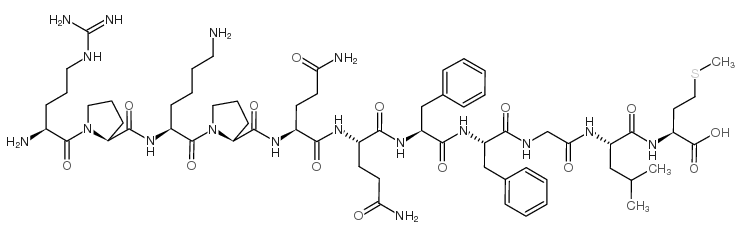
Substance P, Free Acid
CAS No. 71977-09-8
Substance P, Free Acid( —— )
Catalog No. M30486 CAS No. 71977-09-8
Substance P, Free Acid is a native substance P analog, but shows no biological activity of substance P.
Purity : >98% (HPLC)
 COA
Datasheet
HNMR
HPLC
MSDS
Handing Instructions
COA
Datasheet
HNMR
HPLC
MSDS
Handing Instructions
| Size | Price / USD | Stock | Quantity |
| 5MG | 81 | Get Quote |


|
| 10MG | 138 | Get Quote |
|
| 25MG | 279 | Get Quote |
|
| 100MG | Get Quote | Get Quote |
|
| 200MG | Get Quote | Get Quote |
|
| 500MG | Get Quote | Get Quote |
|
| 1G | Get Quote | Get Quote |
|
Biological Information
-
Product NameSubstance P, Free Acid
-
NoteResearch use only, not for human use.
-
Brief DescriptionSubstance P, Free Acid is a native substance P analog, but shows no biological activity of substance P.
-
DescriptionSubstance P, Free Acid is a native substance P analog, but shows no biological activity of substance P.
-
In Vitro——
-
In Vivo——
-
Synonyms——
-
PathwayOthers
-
TargetOther Targets
-
Recptor——
-
Research Area——
-
Indication——
Chemical Information
-
CAS Number71977-09-8
-
Formula Weight1348.61
-
Molecular FormulaC63H97N17O14S
-
Purity>98% (HPLC)
-
Solubility——
-
SMILES——
-
Chemical NameSequence:Arg-Pro-Lys-Pro-Gln-Gln-Phe-Phe-Gly-Leu-Met
Shipping & Storage Information
-
Storage(-20℃)
-
ShippingWith Ice Pack
-
Stability≥ 2 years
Reference
Patel AB, et al. Substance P (free acid) adopts different conformation than native peptide in DMSO, water and DPPC bilayers. J Biomol Struct Dyn. 2001 Aug;19(1):129-38.
molnova catalog



related products
-
AS-604850
AS-604850 is a specific and ATP-competitive PI3Kγ inhibitor (IC50: 250 nM), 18-fold more selective for PI3Kγ than PI3Kα, and over 80-fold selectivity for PI3Kγ than PI3Kδ/β.
-
1-Hydroxy-2-methyl-9...
1-Hydroxy-2-methylanthraquinone exhibits antimicrobial, antioxidant, pesticidal, and anti-inflammatory activities.
-
BTK derived peptide
BTK derived peptide
