


 Cart
Cart
 sales@molnova.com



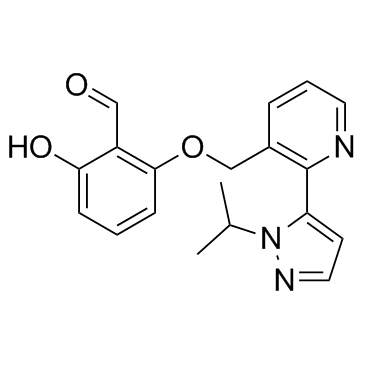
GBT-440
CAS No. 1446321-46-5
GBT-440( GBT 440 | GBT440 | Voxelotor )
Catalog No. M11895 CAS No. 1446321-46-5
A new potent allosteric effector of sickle cell hemoglobin; increases the affinity of hemoglobin for oxygen and consequently inhibits its polymerization when subjected to hypoxic conditions.
Purity : >98% (HPLC)
 COA
Datasheet
HNMR
HPLC
MSDS
Handing Instructions
COA
Datasheet
HNMR
HPLC
MSDS
Handing Instructions
| Size | Price / USD | Stock | Quantity |
| 1 mL x 10 mM in DMSO | 44 | In Stock |


|
| 5MG | 40 | In Stock |
|
| 10MG | 64 | In Stock |
|
| 25MG | 116 | In Stock |
|
| 50MG | 184 | In Stock |
|
| 100MG | 343 | In Stock |
|
| 200MG | 511 | In Stock |
|
| 500MG | Get Quote | In Stock |
|
| 1G | Get Quote | In Stock |
|
Biological Information
-
Product NameGBT-440
-
NoteResearch use only, not for human use.
-
Brief DescriptionA new potent allosteric effector of sickle cell hemoglobin; increases the affinity of hemoglobin for oxygen and consequently inhibits its polymerization when subjected to hypoxic conditions.
-
DescriptionA new potent allosteric effector of sickle cell hemoglobin; increases the affinity of hemoglobin for oxygen and consequently inhibits its polymerization when subjected to hypoxic conditions; orally bioavailable and partitions highly and favorably into the red blood cell with a RBC/plasma ratio of ~150.Anemia Phase 3 Clinical(In Vitro):Voxelotor (GBT440) binds to the N-terminal a chain of haemoglobin (Hb), increases haemoglobin S (HbS) affinity for oxygen, delays in vitro HbS polymerization and prevents sickling of red blood cells (RBCs).(In Vivo):Voxelotor (GBT440; 100-150 mg/kg; administered twice a day by oral gavage for 9-12 days) reduces ex vivo sickling and prolongs red blood cells (RBCs) half-life in a murine model of sickle cell disease (SCD).Voxelotor shows T1/2s of 11.7, 19.1±1.5, 66.0±11, 28.8±4.0 hours for mouse (70 mg/kg; i.v.), rat (1.6 mg/kg; i.v.), dog (1 mg/kg; i.v.), and momkey (1 mg/kg; i.v.), respectively.Voxelotor shows Cmaxs of 81.9, 71.2±6.0, 5.56±1.6, and 25.2±5.5 μg/mL for mouse (30 mg/kg; p.o.), rat (7.2 mg/kg; p.o.), dog (2.5 mg/kg; p.o.), and momkey (4.25 mg/kg; p.o.), respectively.
-
In Vitro——
-
In VivoAnimal Model:HbSS Townes knock-in sickle mice (SS mice)Dosage:100 and 150 mg/kg Administration:Oral administration; twice a day; for 9-12 days Result:Reduced haemolysis.Animal Model:C57BL/6J mice, Sprague-Dawley rats, Beagle dogs and Cynomolgus monkeys Dosage:70, 1.6, 1 and 1 mg/kg for mice, rats, dogs and monkeys, respectively.Oral (PO: 30, 7 2, 2 5 and 4 3 mg/kg, respectively) Result:T1/2s of 11.7, 19.1±1.5, 66.0±11, 28.8±4.0 hours for mouse (70 mg/kg; i.v.), rat (1.6 mg/kg; i.v.), dog (1 mg/kg; i.v.), and momkey (1 mg/kg; i.v.), respectively.Cmaxs of 81.9, 71.2±6.0,5.56±1.6, and 25.2±5.5 μg/mL for mouse (30 mg/kg; p.o.), rat (7.2 mg/kg; p.o.), dog (2.5 mg/kg; p.o.), and momkey (4.25 mg/kg; p.o.), respectively.
-
SynonymsGBT 440 | GBT440 | Voxelotor
-
PathwayOthers
-
TargetOther Targets
-
RecptorOther Targets
-
Research AreaOther Indications
-
IndicationAnemia
Chemical Information
-
CAS Number1446321-46-5
-
Formula Weight337.3725
-
Molecular FormulaC19H19N3O3
-
Purity>98% (HPLC)
-
Solubility10 mM in DMSO
-
SMILESO=CC1=C(OCC2=CC=CN=C2C3=CC=NN3C(C)C)C=CC=C1O
-
Chemical NameBenzaldehyde, 2-hydroxy-6-[[2-[1-(1-methylethyl)-1H-pyrazol-5-yl]-3-pyridinyl]methoxy]-
Shipping & Storage Information
-
Storage(-20℃)
-
ShippingWith Ice Pack
-
Stability≥ 2 years
Reference
1. Metcalf B, et al. ACS Med Chem Lett. 2017 Jan 23;8(3):321-326.
2. Oksenberg D, et al. Br J Haematol. 2016 Oct;175(1):141-53.
3. Dufu K, et al. Hematol Rep. 2016 Sep 28;8(3):6637.
molnova catalog



related products
-
Tryptophol
Tryptophol is a metabolite formed in the liver after disulfiram treatment that induces sleep in humans. It is also a secondary product of alcoholic fermentation.
-
SH2 Domain Ligand (1...
Ac-Asp-Tyr(PO3H2)-Val-Pro-Met-Leu-NH2 is the SH2 domain ligand. SH2 domains participate in protein tyrosine kinase (PTK)-mediated cellular signal.
-
3'-Methoxyflavonol
3'-Methoxyflavonol is a selective agonist of neuromedin U 2 receptor (NMU2R).
