


 Cart
 sales@molnova.com




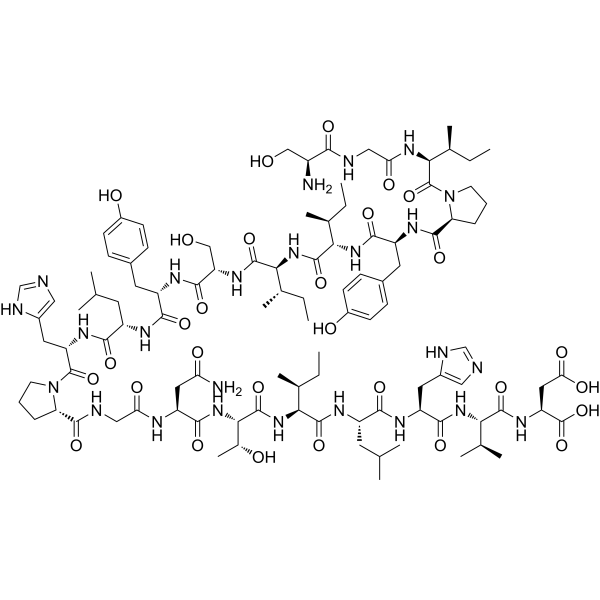
IRBP
CAS No. 211426-18-5
IRBP( Interphotoreceptor Retinoid Binding Protein Fragment IRBP )
Catalog No. M29819 CAS No. 211426-18-5
Interphotoreceptor Retinoid Binding Protein Fragment (IRBP) is a 20-residue peptide, which is a major pathogenic epitope. It exists in the first homologous repeat of interstitial visual pigment Binding Protein peptide (IRBP 161-180) and can induce post-uveitis (EAU).
Purity : >98% (HPLC)
 COA
Datasheet
HNMR
HPLC
MSDS
Handing Instructions
| Size | Price / USD | Stock | Quantity |
| 100MG | Get Quote | Get Quote |


|
| 200MG | Get Quote | Get Quote |
|
| 500MG | Get Quote | Get Quote |
|
| 1G | Get Quote | Get Quote |
|
Biological Information
-
Product NameIRBP
-
NoteResearch use only, not for human use.
-
Brief DescriptionInterphotoreceptor Retinoid Binding Protein Fragment (IRBP) is a 20-residue peptide, which is a major pathogenic epitope. It exists in the first homologous repeat of interstitial visual pigment Binding Protein peptide (IRBP 161-180) and can induce post-uveitis (EAU).
-
DescriptionInterphotoreceptor Retinoid Binding Protein Fragment (IRBP) is a 20-residue peptide, which is a major pathogenic epitope. It exists in the first homologous repeat of interstitial visual pigment Binding Protein peptide (IRBP 161-180) and can induce post-uveitis (EAU).
-
In Vitro——
-
In Vivo——
-
SynonymsInterphotoreceptor Retinoid Binding Protein Fragment IRBP
-
PathwayOthers
-
TargetOther Targets
-
Recptor——
-
Research Area——
-
Indication——
Chemical Information
-
CAS Number211426-18-5
-
Formula Weight2209.5
-
Molecular FormulaC103H157N25O29
-
Purity>98% (HPLC)
-
Solubility——
-
SMILES——
-
Chemical NameSequence:{Ser}{Gly}{Ile}{Pro}{Tyr}{Ile}{Ile}{Ser}{Tyr}{Leu}{His}{Pro}{Gly}{Asn}{Thr}{Ile}{Leu}{His}{Val}{Asp}
Shipping & Storage Information
-
Storage(-20℃)
-
ShippingWith Ice Pack
-
Stability≥ 2 years
Reference
Tang J, et al. Autoimmune uveitis elicited with antigen-pulsed dendritic cells has a distinct clinical signatureand is driven by unique effector mechanisms: initial encounter with autoantigen defines diseasephenotype. J Immunol. 2007 May 1;178(9):5578-87.
molnova catalog


related products
-
α-Synuclein (67-78) ...
α-Synuclein (67-78) (human) is the 67-78 fragment of α-Synuclein. α-Synuclein (67-78) (human) promotes network activity drive and blocks KCl-induced syt1L-ab uptake.
-
ML367
ML367 is a potent inhibitor of ATPase family AAA domain-containing protein 5 (ATAD5) stabilization and acts as a probe molecule that has low micromolar inhibitory activity.
-
Cyclo(Pro-Gly)
Cyclo(Pro-Gly) is an active metabolite of piracetam-N-phenylacetyl-L-prolylglycine (GWS-111), it shows a greater resistance to an enzymatic effect than natural neuropeptides. Cyclo-(Gly-Pro) shows cytotoxicity at the concentration of 10 umol/L, it inhibits the growth of Bacillus subtilis with the minimal inhibitory concentration (MIC) value of 0.8, 0.8 g/L.
