


 Cart
Cart
 sales@molnova.com



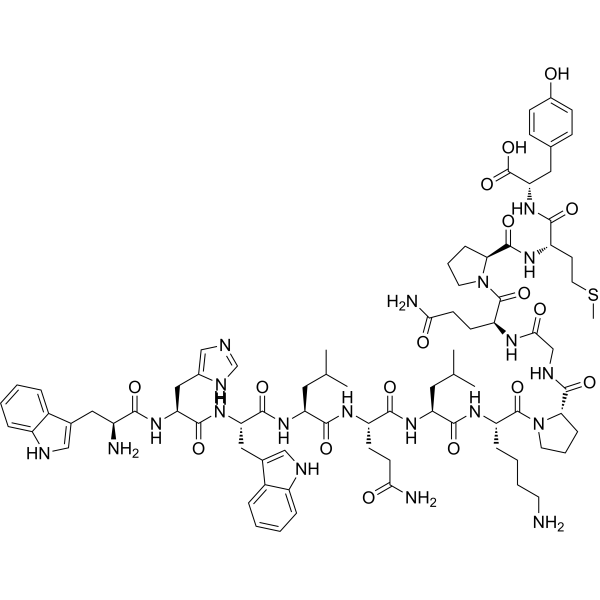
α-Factor Mating Pheromone, yeast
CAS No. 59401-28-4
α-Factor Mating Pheromone, yeast( Mating Factor α )
Catalog No. M29805 CAS No. 59401-28-4
Alpha factor mating pheromone is a peptide of 13 amino acids secreted by Saccharomyces cerevisiae α cells.
Purity : >98% (HPLC)
 COA
Datasheet
HNMR
HPLC
MSDS
Handing Instructions
COA
Datasheet
HNMR
HPLC
MSDS
Handing Instructions
| Size | Price / USD | Stock | Quantity |
| 5MG | 206 | Get Quote |


|
| 10MG | 311 | Get Quote |
|
| 100MG | Get Quote | Get Quote |
|
| 200MG | Get Quote | Get Quote |
|
| 500MG | Get Quote | Get Quote |
|
| 1G | Get Quote | Get Quote |
|
Biological Information
-
Product Nameα-Factor Mating Pheromone, yeast
-
NoteResearch use only, not for human use.
-
Brief DescriptionAlpha factor mating pheromone is a peptide of 13 amino acids secreted by Saccharomyces cerevisiae α cells.
-
DescriptionAlpha factor mating pheromone is a peptide of 13 amino acids secreted by Saccharomyces cerevisiae α cells. (In Vitro):α-Factor Mating Pheromone, yeast is synthesized constitutively by MATα cells and acting on MATa cells. α-Factor Mating Pheromone, yeast inhibits the division cycle of yeast a cells, and competes for binding of 35S-α-factor to haploid a cells, with Kd of 0.3 μM, and this binding is related to five temperature-sensitive ste2 mutants, and is thermolabile. However, α-Factor Mating Pheromone, yeast binding activity of other temperature-sensitive mutants (ste4, ste5, ste7, ste11, and ste12) shows no thermolability.
-
In Vitroα-Factor Mating Pheromone, yeast is synthesized constitutively by MATα cells and acting on MATa cells. α-Factor Mating Pheromone, yeast inhibits the division cycle of yeast a cells, and competes for binding of 35S-α-factor to haploid a cells, with Kd of 0.3 μM, and this binding is related to five temperature-sensitive ste2 mutants, and is thermolabile. However, α-Factor Mating Pheromone, yeast binding activity of other temperature-sensitive mutants (ste4, ste5, ste7, ste11, and ste12) shows no thermolability.
-
In Vivo——
-
SynonymsMating Factor α
-
PathwayOthers
-
TargetOther Targets
-
RecptorSte2p
-
Research Area——
-
Indication——
Chemical Information
-
CAS Number59401-28-4
-
Formula Weight1684
-
Molecular FormulaC82H114N20O17S
-
Purity>98% (HPLC)
-
SolubilityIn Vitro:?H2O : 50 mg/mL (29.69 mM)
-
SMILES——
-
Chemical NameSequence:Trp-His-Trp-Leu-Gln-Leu-Lys-Pro-Gly-Gln-Pro-Met-Tyr
Shipping & Storage Information
-
Storage(-20℃)
-
ShippingWith Ice Pack
-
Stability≥ 2 years
Reference



-
GKI-1
GKI-1 is a Greatwall (GWL) kinase inhibitor with an IC50 of 4.9 for hGWLFL and 2.5 μM for hGWL-KinDom. It exhibits stronger inhibition on ROCK1 with an IC50 of 11 μM and only weakly inhibits PKA.
-
Dehydrocorydaline ni...
Dehydrocorydaline(DHC) not only inhibits antibody-mediated allergic reactions but also influences cell-mediated allergic reactions, and the inhibitory effect of Corydalis Tuber on allergic reactions may be partially attributed to DHC.
-
8-Hydroxygenistein
8-Hydroxygenistein (8-OHG) is an antioxidant that can effectively scavenge nitric oxide (NO) and superoxide anion (O??). 8-Hydroxygenistein belongs to ortho-dihydroxy isoflavones (ODI) and is abundantly present in dark soy sauce and light soy sauce. Its antioxidant activity is stronger than that of its parent compound genistein. The content of 8-Hydroxygenistein is positively correlated with the antioxidant capacity of soy sauce (r = 0.959), and it remains highly stable even after being heated in boiling water for 60 minutes. During the brewing and storage of soy sauce, 8-Hydroxygenistein effectively prevents oxidative damage, making it promising for use in food antioxidant research.
