


 Cart
 sales@molnova.com




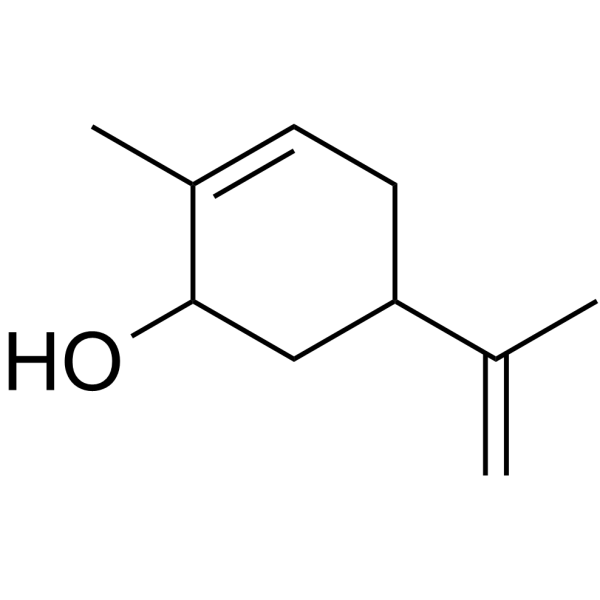
Carveol
CAS No. 99-48-9
Carveol( —— )
Catalog No. M29289 CAS No. 99-48-9
(-)-Carveol, mixture of isomers is a monocyclic monoterpenic alcohol, present in essential oils of plant species such as Cymbopogon giganteus, Illicium pachyphyllum and in spices such as Carum carvi (cumin).
Purity : >98% (HPLC)
 COA
Datasheet
HNMR
HPLC
MSDS
Handing Instructions
| Size | Price / USD | Stock | Quantity |
| 1 mL x 10 mM in DMSO | 28 | In Stock |


|
| 100MG | Get Quote | In Stock |
|
| 200MG | Get Quote | In Stock |
|
| 500MG | 38 | In Stock |
|
| 1G | Get Quote | In Stock |
|
Biological Information
-
Product NameCarveol
-
NoteResearch use only, not for human use.
-
Brief Description(-)-Carveol, mixture of isomers is a monocyclic monoterpenic alcohol, present in essential oils of plant species such as Cymbopogon giganteus, Illicium pachyphyllum and in spices such as Carum carvi (cumin).
-
Description(-)-Carveol, mixture of isomers is a monocyclic monoterpenic alcohol, present in essential oils of plant species such as Cymbopogon giganteus, Illicium pachyphyllum and in spices such as Carum carvi (cumin).(In Vitro):(-)-Carveol exhibited a significant vasorelaxant effect on KCl and 5-HT-induced contractions, obtaining EC50 values of 344.25 ± 8.4 and 175.82 ± 4.05 μM, respectively. The participation of calcium channels in the relaxation produced by (-)-carveol was analyzed using vessels pre-incubated with (-)-carveol (2000 μM) in a calcium-free medium, where the induction of contractions was abolished. The vasorelaxant effect of (-)-carveol on HUAs was reduced by tetraethylammonium (TEA), which increased the (-)-carveol EC50 to 484.87 ± 6.55 μM. The present study revealed that (-)-carveol possesses a vasorelaxant activity in HUAs, which was dependent on the opening of calcium and potassium channels.(In Vivo):(-)-Carveol has low toxicity, with a lethal dose 50% (LD50) equal to or greater than 2,500 mg/kg according to OECD guide no 423. In all gastric ulcer induction methods evaluated, (-)-Carveol (25, 50, 100 and 200 mg/kg, p.o.) significantly reduced the ulcerative lesion in comparison with the respective control groups. In the experimental protocol of pylorus ligation-induced gastric ulcer, (-)-Carveol (100 mg/kg) reduced (p < 0.001) the volume of gastric secretion in both routes (oral and intraduodenal). The previous administration of blockers NEM (sulfhydryl groups blocker), L-NAME (nitric oxide synthesis inhibitor), glibenclamide (KATP channel blocker) and indomethacin (cyclo-oxygenase inhibitor), significantly reduced the gastroprotection exercised by (-)-Carveol, suggesting the participation of these pathways in its gastroprotective activity. In addition, treatment with (-)-Carveol (100 mg/kg) increased (p < 0.001) mucus adhered to the gastric wall. Treatment also increased (p < 0.001) levels of reduced glutathione (GSH), superoxide dismutase (SOD) and interleukin-10 (IL-10). It also reduced (p < 0.001) malondialdehyde (MDA), myeloperoxidase (MPO), interleukin-1 beta (IL-1β) and tumor necrosis factor-alpha (TNF-α) levels.
-
In Vitro——
-
In Vivo——
-
Synonyms——
-
PathwayProteasome/Ubiquitin
-
TargetEndogenous Metabolite
-
RecptorEndogenous Metabolite
-
Research Area——
-
Indication——
Chemical Information
-
CAS Number99-48-9
-
Formula Weight152.23
-
Molecular FormulaC10H16O
-
Purity>98% (HPLC)
-
SolubilityIn Vitro:?DMSO : 100 mg/mL (656.90 mM)
-
SMILESCC(C(C1)CC=C(C)C1O)=C
-
Chemical Name——
Shipping & Storage Information
-
Storage(-20℃)
-
ShippingWith Ice Pack
-
Stability≥ 2 years
Reference
molnova catalog

related products
-
3-Methyl-2-cyclopent...
3-Methyl-2-cyclopenten-1-one, used as a food additive to enhance the flavor of meat and meat products at 2-5 ppm, demonstrated gastric cytoprotective activity when administered orally to male Wistar rats.
-
Spermidine
Spermidine inhibits NOS1 (nNOS). Spermidine binds and precipitates DNA and may be used for purification of DNA binding proteins. Spermidine activates PNK (polynucleotide kinase T4). Spermidine binds to and activates NMDA and has been shown to potentiate NMDA-induced currents in a concentration-dependent manner.
-
Vitamin K
Vitamin K has blood coagulation action and is important for coagulation factors, matrix-Gla protein, and osteocalcin.
