


 Cart
Cart
 sales@molnova.com



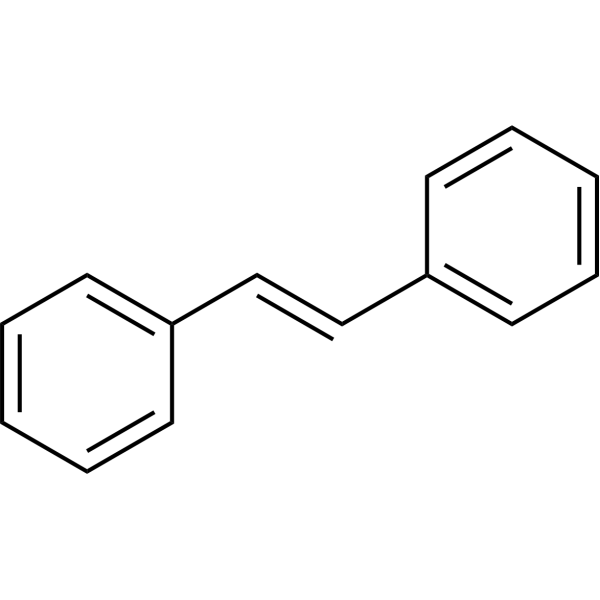
trans-Stilbene
CAS No. 103-30-0
trans-Stilbene( (E)-Stilbene | 1,2-Diphenylethylene (trans) )
Catalog No. M29238 CAS No. 103-30-0
trans-Stilbene is a natural product used in the manufacture of dye lasers, optical brighteners, and non-steroidal synthetic estrogens.
Purity : >98% (HPLC)
 COA
Datasheet
HNMR
HPLC
MSDS
Handing Instructions
COA
Datasheet
HNMR
HPLC
MSDS
Handing Instructions
| Size | Price / USD | Stock | Quantity |
| 1 mL x 10 mM in DMSO | 28 | In Stock |


|
| 100MG | Get Quote | In Stock |
|
| 200MG | Get Quote | In Stock |
|
| 500MG | Get Quote | In Stock |
|
| 1G | 27 | In Stock |
|
Biological Information
-
Product Nametrans-Stilbene
-
NoteResearch use only, not for human use.
-
Brief Descriptiontrans-Stilbene is a natural product used in the manufacture of dye lasers, optical brighteners, and non-steroidal synthetic estrogens.
-
Descriptiontrans-Stilbene is a natural product used in the manufacture of dye lasers, optical brighteners, and non-steroidal synthetic estrogens.
-
In Vitro——
-
In Vivo——
-
Synonyms(E)-Stilbene | 1,2-Diphenylethylene (trans)
-
PathwayOthers
-
TargetOther Targets
-
Recptor——
-
Research Area——
-
Indication——
Chemical Information
-
CAS Number103-30-0
-
Formula Weight180.25
-
Molecular FormulaC14H12
-
Purity>98% (HPLC)
-
SolubilityIn Vitro:?DMSO : 50 mg/mL (277.39 mM)
-
SMILESC(=Cc1ccccc1)c1ccccc1
-
Chemical Name——
Shipping & Storage Information
-
Storage(-20℃)
-
ShippingWith Ice Pack
-
Stability≥ 2 years
Reference
molnova catalog



related products
-
Methyl stearate
Methyl stearate is found in cloves. Antifoaming agent and fermentation nutrient.
-
Ethyleneurea
2-Imidazolidinone is used as a formaldehyde scavenger and intermediate.
-
Nemvaleukin alfa
Nemvaleukin alfa (ALKS 4230) is an interleukin 2 fusion protein, a selective agonist of the medium-affinity IL-2 receptor, produced by fusion of the IL-2Ralpha subunit of the circularly arranged interleukin-2 (IL-2) and IL-2 receptor (IL-2R) complexes, which drives antitumor Immunity and inhibits tumor growth in small cell lung cancer.
