


 Cart
Cart
 sales@molnova.com



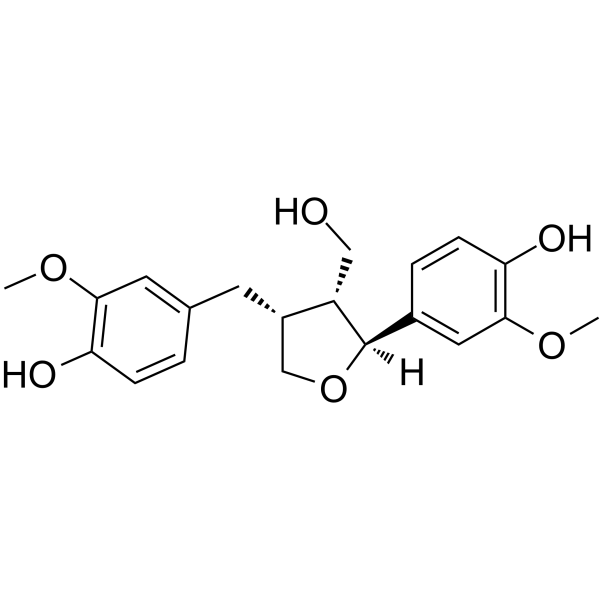
Lariciresinol
CAS No. 27003-73-2
Lariciresinol( —— )
Catalog No. M29177 CAS No. 27003-73-2
Lariciresinol is an enterolignan precursor, it possesses fungicidal activities by disrupting the fungal plasma membrane and therapeutic potential as a novel antifungal agent for the treatment of fungal infectious diseases in humans. Dietary lariciresinol can attenuate mammary tumor growth and reduce blood vessel density in human MCF-7 breast cancer xenografts and carcinogen-induced mammary tumors in rats.
Purity : >98% (HPLC)
 COA
Datasheet
HNMR
HPLC
MSDS
Handing Instructions
COA
Datasheet
HNMR
HPLC
MSDS
Handing Instructions
| Size | Price / USD | Stock | Quantity |
| 1 mL x 10 mM in DMSO | 417 | In Stock |


|
| 5MG | 411 | In Stock |
|
| 10MG | 606 | In Stock |
|
| 25MG | 938 | In Stock |
|
| 100MG | Get Quote | In Stock |
|
| 200MG | Get Quote | In Stock |
|
| 500MG | Get Quote | In Stock |
|
| 1G | Get Quote | In Stock |
|
Biological Information
-
Product NameLariciresinol
-
NoteResearch use only, not for human use.
-
Brief DescriptionLariciresinol is an enterolignan precursor, it possesses fungicidal activities by disrupting the fungal plasma membrane and therapeutic potential as a novel antifungal agent for the treatment of fungal infectious diseases in humans. Dietary lariciresinol can attenuate mammary tumor growth and reduce blood vessel density in human MCF-7 breast cancer xenografts and carcinogen-induced mammary tumors in rats.
-
DescriptionLariciresinol is an enterolignan precursor, it possesses fungicidal activities by disrupting the fungal plasma membrane and therapeutic potential as a novel antifungal agent for the treatment of fungal infectious diseases in humans. Dietary lariciresinol can attenuate mammary tumor growth and reduce blood vessel density in human MCF-7 breast cancer xenografts and carcinogen-induced mammary tumors in rats.(In Vitro):In this study, the antifungal properties and mode of action of Lariciresinol were investigated. Lariciresinol displays potent antifungal properties against several human pathogenic fungal strains without hemolytic effects on human erythrocytes. To understand the antifungal mechanism of action of Lariciresinol, the membrane interactions of Lariciresinol were examined. Fluorescence analysis using the membrane probe 3,3'-diethylthio-dicarbocyanine iodide (DiSC(3)-5) and 1,6-diphenyl-1,3,5-hexatriene (DPH), as well as a flow cytometric analysis with propidium iodide (PI), a membrane-impermeable dye, indicated that Lariciresinol was associated with lipid bilayers and induced membrane permeabilization.
-
In Vitro——
-
In Vivo——
-
Synonyms——
-
PathwayAngiogenesis
-
TargetVEGFR
-
RecptorVEGFR
-
Research Area——
-
Indication——
Chemical Information
-
CAS Number27003-73-2
-
Formula Weight360.406
-
Molecular FormulaC20H24O6
-
Purity>98% (HPLC)
-
SolubilityIn Vitro:?DMSO : 100 mg/mL (277.47 mM)
-
SMILESCOc1cc(C[C@H]2CO[C@@H]([C@H]2CO)c2ccc(O)c(OC)c2)ccc1O
-
Chemical Name——
Shipping & Storage Information
-
Storage(-20℃)
-
ShippingWith Ice Pack
-
Stability≥ 2 years
Reference
molnova catalog



related products
-
Motesanib diphosphat...
A potent, orally bioavailable, multikinase inhibitor inhibitor of VEGFR1/2/3, PDGFR and c-Kit with IC50 of 2-6 nM, 84 nM and 8 nM, respectively.
-
BIBF 1202
BIBF 1202 is a VEGFR2 kinase inhibitor (IC50 = 62 nM).
-
Cabozantinib (S-mala...
Cabozantinib (XL184) is a potent, multi-kinase inhibitor that inhibits VEGFR2, c-Met, Kit, Axl and Flt3 with IC50 of 0.035, 1.3, 4.6, 7 and 11.3 nM, respectively.
