


 Cart
Cart
 sales@molnova.com



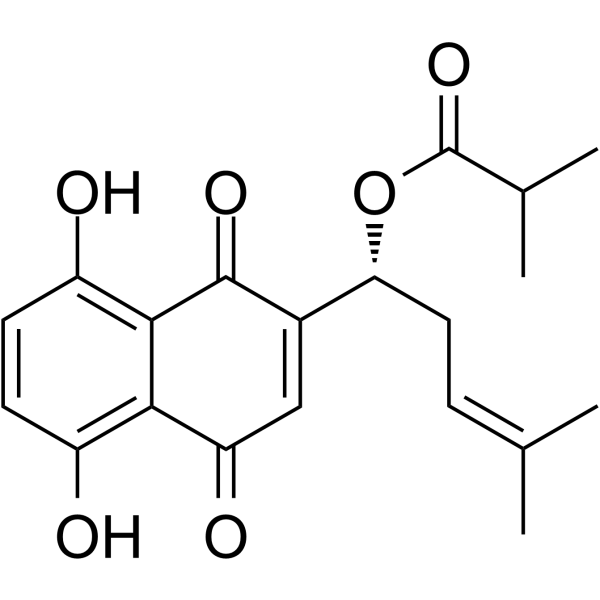
Isobutylshikonin
CAS No. 52438-12-7
Isobutylshikonin( —— )
Catalog No. M29058 CAS No. 52438-12-7
Isobutylshikonin exhibits obvious antioxidant activities , it exerts very good radical scavenging activities toward ABTS+ but shows moderate inhibition of DPPH·.
Purity : >98% (HPLC)
 COA
Datasheet
HNMR
HPLC
MSDS
Handing Instructions
COA
Datasheet
HNMR
HPLC
MSDS
Handing Instructions
| Size | Price / USD | Stock | Quantity |
| 5MG | 155 | In Stock |


|
| 10MG | 235 | In Stock |
|
| 25MG | 404 | In Stock |
|
| 50MG | 575 | In Stock |
|
| 100MG | 812 | In Stock |
|
| 200MG | Get Quote | In Stock |
|
| 500MG | Get Quote | In Stock |
|
| 1G | Get Quote | In Stock |
|
Biological Information
-
Product NameIsobutylshikonin
-
NoteResearch use only, not for human use.
-
Brief DescriptionIsobutylshikonin exhibits obvious antioxidant activities , it exerts very good radical scavenging activities toward ABTS+ but shows moderate inhibition of DPPH·.
-
DescriptionIsobutylshikonin exhibits obvious antioxidant activities , it exerts very good radical scavenging activities toward ABTS+ but shows moderate inhibition of DPPH·.(In Vitro):Five red shikonin pigments, deoxyshikonin, shikonin, acetylshikonin, Isobutylshikonin, and beta-hydroxyisovalerylshikonin, were isolated from the roots of Lithospermum erythrorhizon cultivated in Korea. The purified pigments were red, purple, and blue at acidic, neutral, and alkaline pH values, respectively. Physical stability of the purified pigments against heat and light in an aqueous solution was examined for possible value-added food colorants. The thermal degradation reactions were carried out at pH 3.0 (50 mM glycine buffer) in 50% EtOH/H(2)O. Deoxyshikonin (t(1/2) = 14.6 h, 60 degrees C) and isobutylshikinin (t(1/2) = 19.3 h, 60 degrees C) are relatively less stable than other shikonin derivatives (t(1/2) = 40-50 h, 60 degrees C). Activation energies of thermal degradation of the isolated pigments were calculated. The activation energy of deoxyshikonin was the highest (12.5 kcal mol(-)(1)) and that of beta-hydroxyisovalerylshikonin was the lowest (1.71 kcal mol(-)(1)) value.
-
In Vitro——
-
In Vivo——
-
Synonyms——
-
PathwayOthers
-
TargetOther Targets
-
Recptor——
-
Research Area——
-
Indication——
Chemical Information
-
CAS Number52438-12-7
-
Formula Weight358.39
-
Molecular FormulaC20H22O6
-
Purity>98% (HPLC)
-
SolubilityIn Vitro:?DMSO : 10 mg/mL (27.90 mM)
-
SMILESCC(C)C(=O)O[C@H](CC=C(C)C)C1=CC(=O)c2c(O)ccc(O)c2C1=O
-
Chemical Name——
Shipping & Storage Information
-
Storage(-20℃)
-
ShippingWith Ice Pack
-
Stability≥ 2 years
Reference
molnova catalog



related products
-
AzoMethine-H Monosod...
AzoMethine-H Monosodium salt hydrate is a reagent used for the colorimetric determination of boron in soil, plants, composts, manure, water and nutrient solutions.
-
Tyr-Amyloid P Compon...
Tyr-Amyloid P Component (27-38) amide
-
Menbutone
Menbutone is an organic compound with fomula C15H14O4.
