


 Cart
Cart
 sales@molnova.com



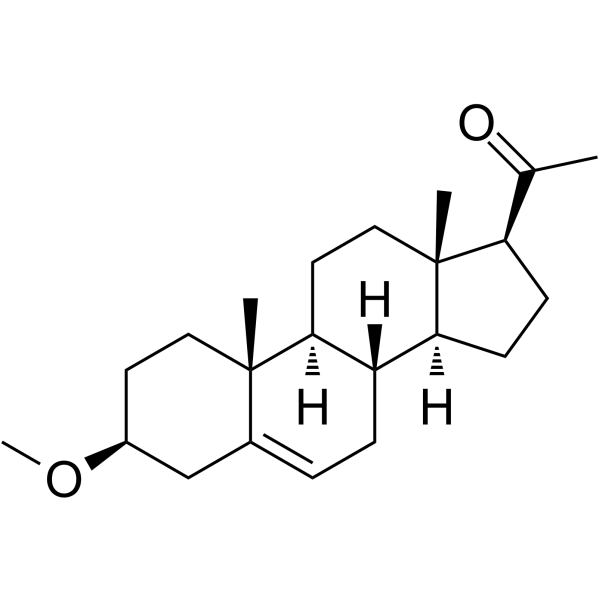
MAP4343
CAS No. 511-26-2
MAP4343( —— )
Catalog No. M28721 CAS No. 511-26-2
Map4343 is a 3-methyl ether derivative of pregnenolone. Map4343 binds to microtubule associated protein 2 (MAP2) in vitro and stimulates tubulin polymerization, resulting in enhanced neurite extension and protection of neurons from neurotoxic agents.
Purity : >98% (HPLC)
 COA
Datasheet
HNMR
HPLC
MSDS
Handing Instructions
COA
Datasheet
HNMR
HPLC
MSDS
Handing Instructions
| Size | Price / USD | Stock | Quantity |
| 1 mL x 10 mM in DMSO | 50 | In Stock |


|
| 2MG | 29 | In Stock |
|
| 5MG | 46 | In Stock |
|
| 10MG | 79 | In Stock |
|
| 25MG | 163 | In Stock |
|
| 50MG | 263 | In Stock |
|
| 100MG | 387 | In Stock |
|
| 200MG | Get Quote | In Stock |
|
| 500MG | Get Quote | In Stock |
|
| 1G | Get Quote | In Stock |
|
Biological Information
-
Product NameMAP4343
-
NoteResearch use only, not for human use.
-
Brief DescriptionMap4343 is a 3-methyl ether derivative of pregnenolone. Map4343 binds to microtubule associated protein 2 (MAP2) in vitro and stimulates tubulin polymerization, resulting in enhanced neurite extension and protection of neurons from neurotoxic agents.
-
DescriptionMap4343 is a 3-methyl ether derivative of pregnenolone. Map4343 binds to microtubule associated protein 2 (MAP2) in vitro and stimulates tubulin polymerization, resulting in enhanced neurite extension and protection of neurons from neurotoxic agents.
-
In VitroMAP4343 (40 μM; 15 or 30 min) stimulates microtubule polymerization in vitro.MAP4343 (30 μM; 2-8 d) stimulates nerve growth factor (NGF)-induced neurite outgrowth in PC12 cells.MAP4343 (20 μM; 1 h) protects against microtubule depolymerization induced by Nocodazole in PC12 cells .
-
In VivoMAP4343 (12 mg/kg; daily s.c. for 28 d) improves the recovery of locomotor function after spinal cord injury (SCI) in rats.MAP4343 (4 mg/kg; daily s.c. for 6 d) increases MAP2 levels in spinal cord after SCI in rats.MAP4343 (4 mg/kg; daily s.c. for 6 d) increases the size of lumbar spinal motoneurons' dendrite arbours after SCI in rats. Animal Model:Adult Sprague-Dawley male rats with spinal cord injuryDosage:12 mg/kg Administration:Daily s.c. for 28 days Result:Increased the number of animals able to walk with weight-supported plantar steps.Showed forelimb-hindlimb coordination at the end of the study.
-
Synonyms——
-
PathwayCytoskeleton/Cell Adhesion Molecules
-
TargetMicrotubule/Tubulin
-
Recptor——
-
Research Area——
-
Indication——
Chemical Information
-
CAS Number511-26-2
-
Formula Weight660
-
Molecular FormulaC44H67O4
-
Purity>98% (HPLC)
-
SolubilityIn Vitro:?DMSO : 25 mg/mL (75.64 mM)
-
SMILESC[C@](CC1)([C@@H](CC2)[C@H]3[C@H]1[C@@](C)(CC[C@@H](C1)OC)C1=CC3)[C@H]2C(C)=OC[C@](CC1)([C@@H](CC2)[C@H]3[C@H]1[C@@](C)(CC[C@@H](C1)OC)C1=CC3)[C@H]2C(C)=O
-
Chemical Name——
Shipping & Storage Information
-
Storage(-20℃)
-
ShippingWith Ice Pack
-
Stability≥ 2 years
Reference
1.Tran DN, Cramer N. Biomimetic synthesis of (+)-ledene, (+)-viridiflorol, (-)-palustrol, (+)-spathulenol, and psiguadial A, C, and D via the platform terpene (+)-bicyclogermacrene. Chemistry. 2014 Aug 18;20(34):10654-60.
molnova catalog



related products
-
MPT0B098
A potent microtubule inhibitor that not only inhibits the expression levels of HIF-1α protein but also destabilizes HIF-1α mRNA.
-
Avanbulin
Avanbulin (BAL27862, BAL-27862) is a novel microtubule-destabilizing agent that potently inhibits tubulin assembly at 37°C with IC50 of 1.4 uM in tubulin-binding assays.
-
Isosorbide Mononitra...
Isosorbide mononitrate is a Nitrate Vasodilator, dilating the blood vessels so as to reduce the blood pressure.
