


 Cart
Cart
 sales@molnova.com



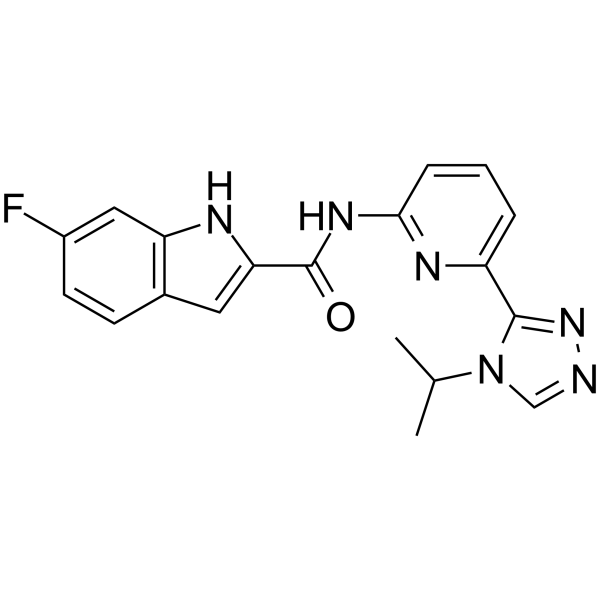
ASK1-IN-2
CAS No. 2541792-70-3
ASK1-IN-2( —— )
Catalog No. M28644 CAS No. 2541792-70-3
ASK1-IN-2 is a potent and orally active inhibitor of apoptosis signal-regulating kinase 1 (ASK1), with an IC50 of 32.8 nM. ASK1-IN-2 can potentially be used as a therapeutic strategy for ulcerative colitis.
Purity : >98% (HPLC)
 COA
Datasheet
HNMR
HPLC
MSDS
Handing Instructions
COA
Datasheet
HNMR
HPLC
MSDS
Handing Instructions
| Size | Price / USD | Stock | Quantity |
| 1 mL x 10 mM in DMSO | 170 | In Stock |


|
| 5MG | 155 | In Stock |
|
| 10MG | 250 | In Stock |
|
| 25MG | 452 | In Stock |
|
| 50MG | 665 | In Stock |
|
| 100MG | 995 | In Stock |
|
| 200MG | Get Quote | In Stock |
|
| 500MG | Get Quote | In Stock |
|
| 1G | Get Quote | In Stock |
|
Biological Information
-
Product NameASK1-IN-2
-
NoteResearch use only, not for human use.
-
Brief DescriptionASK1-IN-2 is a potent and orally active inhibitor of apoptosis signal-regulating kinase 1 (ASK1), with an IC50 of 32.8 nM. ASK1-IN-2 can potentially be used as a therapeutic strategy for ulcerative colitis.
-
DescriptionASK1-IN-2 is a potent and orally active inhibitor of apoptosis signal-regulating kinase 1 (ASK1), with an IC50 of 32.8 nM. ASK1-IN-2 can potentially be used as a therapeutic strategy for ulcerative colitis.(In Vitro):ASK1-IN-2 displays potent anti-ASK1 kinase activity and strong inhibitory effect on ASK1 in AP1-HEK293 cells with inhibition rate of 95.59%.(In Vivo):ASK1-IN-2 (1 mg/kg; i.v.) shows low clearance (CL=1.38 L/h/kg) and moderate half-life (T1/2=1.45 h) in rats. ASK1-IN-2 (10 mg/kg; p.o.) shows high oral exposure (AUClast=4517 h ng/mL), 62.2% oral bioavailability and acceptable terminal half-life (T1/2=2.31 h) in rats. ASK1-IN-2 (25 mg/kg; p.o. daily for 7 d) improves dextran sulphate sodium (DSS)-induced ulcerative colitis (UC) in mice. ASK1-IN-2 (25 mg/kg; p.o. daily for 7 d) blocks ASK1-p38/JNK signaling pathways and reduces inflammatory cytokine levels in DSS-induced mouse colon tissues.
-
In VitroASK1-IN-2 (compound 19) (10 mM; 1 h) inhibits the luciferase reporter activity in AP1-HEK293 cells, with inhibition rate of 95.59%.
-
In VivoASK1-IN-2 (25 mg/kg; p.o. daily for 7 d) improves dextran sulphate sodium (DSS)-induced ulcerative colitis (UC) in mice.ASK1-IN-2 (25 mg/kg; p.o. daily for 7 d) blocks ASK1-p38/JNK signaling pathways and reduces inflammatory cytokine levels in DSS-induced mouse colon tissues.ASK1-IN-2 (1 mg/kg; i.v.) shows low clearance (CL=1.38 L/h/kg) and moderate half-life (T1/2=1.45 h) in rats.ASK1-IN-2 (10 mg/kg; p.o.) shows high oral exposure (AUClast=4517 h?ng/mL), 62.2% oral bioavailability and acceptable terminal half-life (T1/2=2.31 h) in rats. Animal Model:Male ICR mice (18-22 g, 6-8 weeks) were given 3% DSS (w/v) orally in drinking waterDosage:25 mg/kg Administration:P.o. daily for 7 days Result:Induced a significant recovery of body weight loss, with an increase of +11.2%.Decreased the disease activity index (DAI) score about a 2 unit.Significantly prevented colon shortening.Attenuated a severe colonic tissue damage and infiltration of inflammatory cells.Animal Model:Male SD rats Dosage:1 mg/kg for i.v.; 10 mg/kg for p.o. (Pharmacokinetic Analysis) Administration:I.v. and p.o. administration Result:I.v.: CL=1.38 L/h/kg; T1/2=1.45 h.P.o.: AUClast=4517 h?ng/mL; F=62.2%; T1/2=2.31 h.
-
Synonyms——
-
PathwayApoptosis
-
TargetApoptosis
-
RecptorPLK2|PLK3|PLK1
-
Research Area——
-
Indication——
Chemical Information
-
CAS Number2541792-70-3
-
Formula Weight364.38
-
Molecular FormulaC19H17FN6O
-
Purity>98% (HPLC)
-
SolubilityIn Vitro:?DMSO : 250 mg/mL (686.10 mM)
-
SMILESCC(C)n1c(-c2cccc(NC(c3cc(ccc(F)c4)c4[nH]3)=O)n2)nnc1
-
Chemical Name——
Shipping & Storage Information
-
Storage(-20℃)
-
ShippingWith Ice Pack
-
Stability≥ 2 years
Reference
1.Hanan EJ, et al. Design and synthesis of 2-amino-isoxazolopyridines as Polo-like kinase inhibitors. Bioorg Med Chem Lett. 2008 Oct 1;18(19):5186-9.
molnova catalog



related products
-
Citric acid
Citric acid is a weak organic tricarboxylic acid found in citrus fruits.
-
Tetrac
Tetrac (Tetraiodothyroacetic acid) is a derivative of L-thyroxine (T4), a thyroxine integrin receptor antagonist.Tetrac induces antiproliferation by blocking EGFR-mediated cell signaling in colorectal cancer cells.
-
Trk-IN-9
Trk-IN-9 (Compound 12) is a potent inhibitor of TRK that inhibits the proliferation of Km-12 cell lines and induces apoptosis in a concentration-dependent manner.
