


 Cart
Cart
 sales@molnova.com



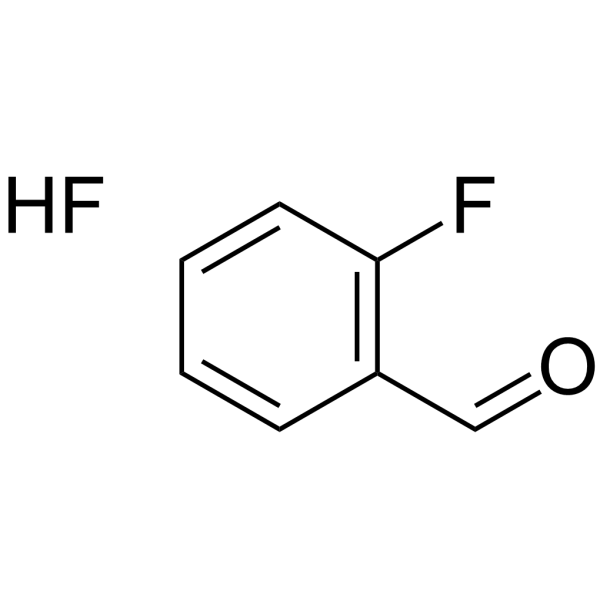
2,4-Difluorobenzaldehyde
CAS No. 1550-35-2
2,4-Difluorobenzaldehyde( 2,4-Difluoro-benzaldehyde )
Catalog No. M28626 CAS No. 1550-35-2
2,4-Difluorobenzaldehyde target bont - botulinum neurotoxin type A (Clostridium botulinum).
Purity : >98% (HPLC)
 COA
Datasheet
HNMR
HPLC
MSDS
Handing Instructions
COA
Datasheet
HNMR
HPLC
MSDS
Handing Instructions
| Size | Price / USD | Stock | Quantity |
| 1 mL x 10 mM in DMSO | 28 | In Stock |


|
| 5MG | 49 | In Stock |
|
| 100MG | Get Quote | In Stock |
|
| 200MG | Get Quote | In Stock |
|
| 500MG | Get Quote | In Stock |
|
| 1G | Get Quote | In Stock |
|
Biological Information
-
Product Name2,4-Difluorobenzaldehyde
-
NoteResearch use only, not for human use.
-
Brief Description2,4-Difluorobenzaldehyde target bont - botulinum neurotoxin type A (Clostridium botulinum).
-
Description2,4-Difluorobenzaldehyde target bont - botulinum neurotoxin type A (Clostridium botulinum).
-
In Vitro——
-
In Vivo——
-
Synonyms2,4-Difluoro-benzaldehyde
-
PathwayOthers
-
TargetOther Targets
-
Recptor——
-
Research Area——
-
Indication——
Chemical Information
-
CAS Number1550-35-2
-
Formula Weight142.1
-
Molecular FormulaC7H4F2O
-
Purity>98% (HPLC)
-
SolubilityIn Vitro:?DMSO : 100 mg/mL (703.73 mM)
-
SMILESO=Cc(ccc(F)c1)c1F
-
Chemical Name——
Shipping & Storage Information
-
Storage(-20℃)
-
ShippingWith Ice Pack
-
Stability≥ 2 years
Reference



-
Androstenediol
5-Androstenediol is an analytical reference standard categorized as an anabolic androgenic steroid.
-
12-Dipalmitoyl-sn-gl...
12-Dipalmitoyl-sn-glycerol is an analog of the PKC-activating second messenger diacylglycerol (DAG). It weakly activates PKC.
-
Egg Laying Hormone, ...
Egg-laying hormone (ELH) is a neuropeptide synthesized by the bag cell neurons, Egg-laying hormone (ELH) induces egg laying and its correlated behavior in Aplysia californica. Egg-laying hormone (ELH) has been purified to homogeneity and Egg-laying hormone (ELH)'s primary structure has been determined. Egg-laying hormone (ELH) have 36 amino acid residues with a Mr of 4385 and a calculated isoelectric point of 9.7. Egg Laying Hormone of Aplysia induces a voltage-dependent slow inward current carried by Na+ in an identified motoneuron.
