


 Cart
Cart
 sales@molnova.com



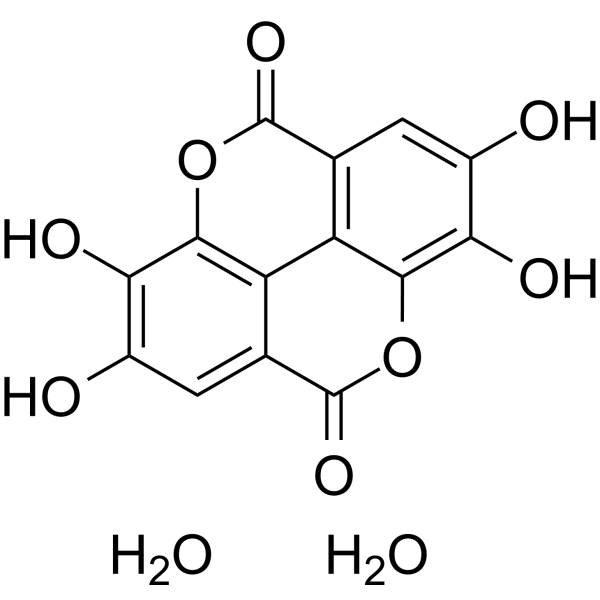
Ellagic Acid Dihydrate
CAS No. 133039-73-3
Ellagic Acid Dihydrate( —— )
Catalog No. M28607 CAS No. 133039-73-3
Ellagic Acid Dihydrate inhibit the CYP1A1-dependent activation of benzo[a]pyrene.
Purity : >98% (HPLC)
 COA
Datasheet
HNMR
HPLC
MSDS
Handing Instructions
COA
Datasheet
HNMR
HPLC
MSDS
Handing Instructions
| Size | Price / USD | Stock | Quantity |
| 1 mL x 10 mM in DMSO | 37 | In Stock |


|
| 100MG | Get Quote | In Stock |
|
| 200MG | 30 | In Stock |
|
| 500MG | 41 | In Stock |
|
| 1G | 58 | In Stock |
|
Biological Information
-
Product NameEllagic Acid Dihydrate
-
NoteResearch use only, not for human use.
-
Brief DescriptionEllagic Acid Dihydrate inhibit the CYP1A1-dependent activation of benzo[a]pyrene.
-
DescriptionEllagic Acid Dihydrate inhibit the CYP1A1-dependent activation of benzo[a]pyrene.
-
In Vitro——
-
In Vivo——
-
Synonyms——
-
PathwayMetabolic Enzyme/Protease
-
TargetP450
-
Recptorcalmodulin
-
Research Area——
-
Indication——
Chemical Information
-
CAS Number133039-73-3
-
Formula Weight338.22
-
Molecular FormulaC14H10O10
-
Purity>98% (HPLC)
-
Solubility——
-
SMILESO=C1C2=CC(O)=C(O)C(O3)=C2C4=C(C3=O)C=C(O)C(O)=C4O1.[H]O[H].[H]O[H]
-
Chemical Name——
Shipping & Storage Information
-
Storage(-20℃)
-
ShippingWith Ice Pack
-
Stability≥ 2 years
Reference
1.Kikuchi Y, Iwano I, Kato K. Effects of calmodulin antagonists on human ovarian cancer cell proliferation in vitro. Biochem Biophys Res Commun. 1984 Aug 30;123(1):385-92.
molnova catalog



related products
-
Quinidine sulfate
Quinidine sulfate dihydrate is a potent and selective cytochrome P450db??inhibitor.
-
Hypaconitine
Hypaconitine an active and highly toxic constituent derived from Aconitum species has anti-inflammatory activity is widely used to treat rheumatism.
-
7-Ethoxyresorufin
7-Ethoxyresorufin (7-ER) is a fluorometric substrate for and competitive inhibitor of cytochrome P450, especially CYP1A1.
