


 Cart
Cart
 sales@molnova.com



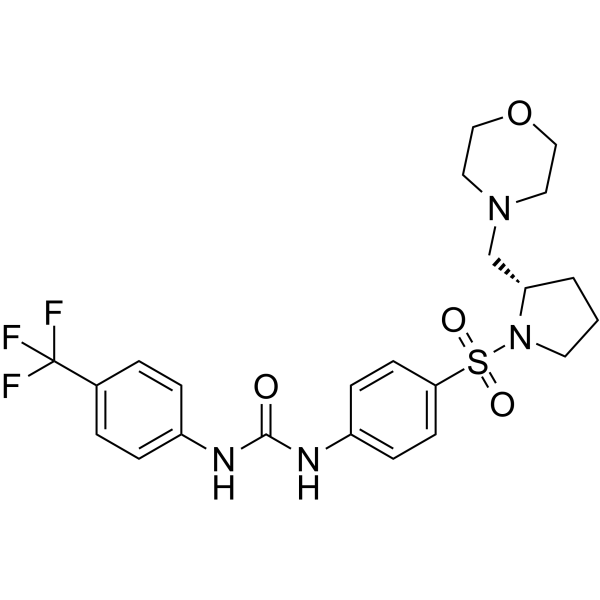
ZL0590
CAS No. 2230496-99-6
ZL0590( —— )
Catalog No. M28525 CAS No. 2230496-99-6
ZL0590 is an effective and selective inhibitor of BD1-BRD4 (IC50 = 90 nM) with anti-inflammatory activities.
Purity : >98% (HPLC)
 COA
Datasheet
HNMR
HPLC
MSDS
Handing Instructions
COA
Datasheet
HNMR
HPLC
MSDS
Handing Instructions
| Size | Price / USD | Stock | Quantity |
| 1 mL x 10 mM in DMSO | 177 | In Stock |


|
| 5MG | 155 | In Stock |
|
| 10MG | 235 | In Stock |
|
| 25MG | 424 | In Stock |
|
| 50MG | 621 | In Stock |
|
| 100MG | 916 | In Stock |
|
| 200MG | Get Quote | In Stock |
|
| 500MG | Get Quote | In Stock |
|
| 1G | Get Quote | In Stock |
|
Biological Information
-
Product NameZL0590
-
NoteResearch use only, not for human use.
-
Brief DescriptionZL0590 is an effective and selective inhibitor of BD1-BRD4 (IC50 = 90 nM) with anti-inflammatory activities.
-
DescriptionZL0590 is an effective and selective inhibitor of BD1-BRD4 (IC50 = 90 nM) with anti-inflammatory activities.
-
In Vitro——
-
In Vivo——
-
Synonyms——
-
PathwayChromatin/Epigenetic
-
TargetEpigenetic Reader Domain
-
Recptor——
-
Research Area——
-
Indication——
Chemical Information
-
CAS Number2230496-99-6
-
Formula Weight512.55
-
Molecular FormulaC23H27F3N4O4S
-
Purity>98% (HPLC)
-
SolubilityIn Vitro:?DMSO : 100 mg/mL (195.10 mM)
-
SMILESS(=O)(=O)(N1[C@H](CN2CCOCC2)CCC1)C3=CC=C(NC(NC4=CC=C(C(F)(F)F)C=C4)=O)C=C3
-
Chemical Name——
Shipping & Storage Information
-
Storage(-20℃)
-
ShippingWith Ice Pack
-
Stability≥ 2 years
Reference
molnova catalog



related products
-
Histone Acetyltransf...
Histone Acetyltransferase Inhibitor II is a selective and cell permeable inhibitor of p300 histone acetyltransferase(IC50 : 5 μM).with anti-acetylase activity in mammalian cells.
-
Pocenbrodib
Pocenbrodib (FT-7051) is a potent inhibitor of the bromodomain of the CBP/p300 family with potential antitumour activity and is palatable for cancer research.
-
BRD4-BD1-IN-2
BRD4-BD1-IN-2 is a selective and potent BRD4-BD1 inhibitor with an IC50 value of 2.51 μM, exhibiting 20-fold greater inhibitory activity against BRD4-BD1 compared to BRD4-BD2.
