


 Cart
Cart
 sales@molnova.com



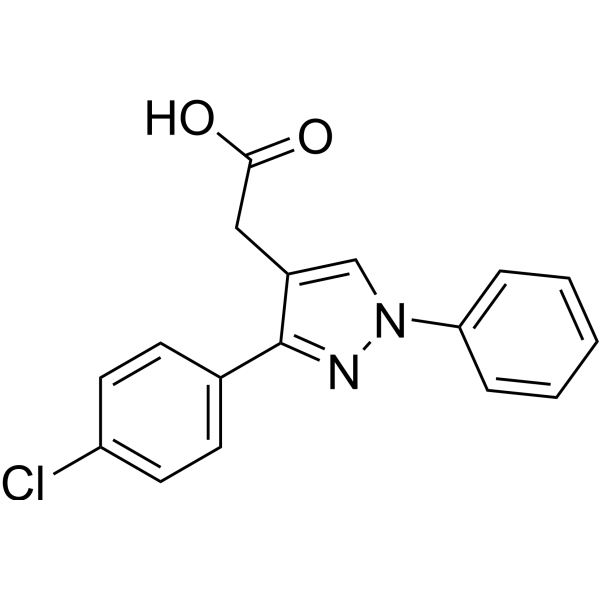
Lonazolac
CAS No. 53808-88-1
Lonazolac( —— )
Catalog No. M28394 CAS No. 53808-88-1
Lonazolac is a nonsteroidal anti-inflammatory drug.
Purity : >98% (HPLC)
 COA
Datasheet
HNMR
HPLC
MSDS
Handing Instructions
COA
Datasheet
HNMR
HPLC
MSDS
Handing Instructions
| Size | Price / USD | Stock | Quantity |
| 1 mL x 10 mM in DMSO | 65 | In Stock |


|
| 5MG | 49 | In Stock |
|
| 10MG | 74 | In Stock |
|
| 25MG | 126 | In Stock |
|
| 50MG | 184 | In Stock |
|
| 100MG | 277 | In Stock |
|
| 200MG | 418 | In Stock |
|
| 500MG | Get Quote | In Stock |
|
| 1G | Get Quote | In Stock |
|
Biological Information
-
Product NameLonazolac
-
NoteResearch use only, not for human use.
-
Brief DescriptionLonazolac is a nonsteroidal anti-inflammatory drug.
-
DescriptionLonazolac is a nonsteroidal anti-inflammatory drug.
-
In Vitro——
-
In Vivo——
-
Synonyms——
-
PathwayMetabolic Enzyme/Protease
-
TargetPPAR
-
Recptor——
-
Research Area——
-
Indication——
Chemical Information
-
CAS Number53808-88-1
-
Formula Weight312.75
-
Molecular FormulaC17H13ClN2O2
-
Purity>98% (HPLC)
-
Solubility——
-
SMILESOC(=O)Cc1cn(nc1-c1ccc(Cl)cc1)-c1ccccc1
-
Chemical Name——
Shipping & Storage Information
-
Storage(-20℃)
-
ShippingWith Ice Pack
-
Stability≥ 2 years
Reference
1.Foster SJ, et al. Anti-proliferative properties of Clozic, a disease-modifying anti-arthritic agent. Biochem Pharmacol. 1983 Feb 1;32(3):461-7.
molnova catalog



related products
-
T0070907
T0070907 is a potent and selective PPARγ inhibitor with IC50 of 1 nM.
-
Fonadelpar
Fonadelpar (NPS-005,SJP-0035) is a potent, selective peroxisome proliferator activated receptor δ (PPARδ) agonist for the treatment of corneal disorders.
-
CGS 15435
CGS 15435 is a potent thromboxen (TxA2) synthetase inhibitor (IC50: 1 nM). CGS 15435 acts on PGI2 synthase, cyclooxygenase and liposynthase with much less selectivity than on thromboxin synthase.
