


 Cart
Cart
 sales@molnova.com



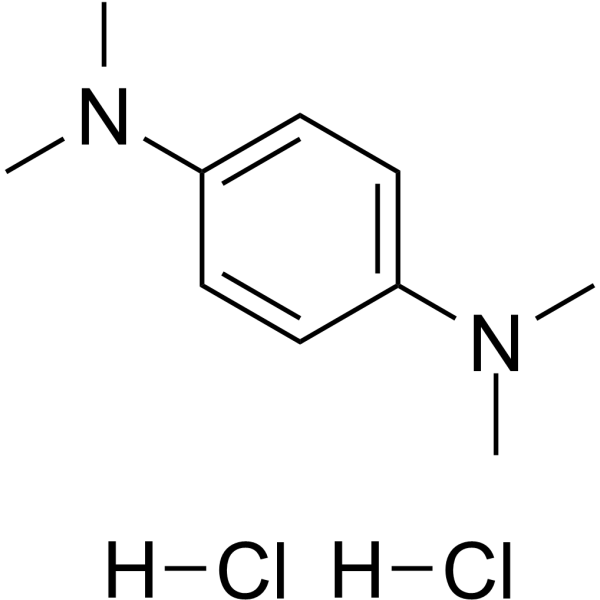
TMPD dihydrochloride
CAS No. 637-01-4
TMPD dihydrochloride( —— )
Catalog No. M28331 CAS No. 637-01-4
TMPD dihydrochloride is an active substrate of enzymatically convert redox and an electron donor for the reduction of heme peroxidases.
Purity : >98% (HPLC)
 COA
Datasheet
HNMR
HPLC
MSDS
Handing Instructions
COA
Datasheet
HNMR
HPLC
MSDS
Handing Instructions
| Size | Price / USD | Stock | Quantity |
| 100MG | Get Quote | In Stock |


|
| 200MG | Get Quote | In Stock |
|
| 500MG | Get Quote | In Stock |
|
| 1G | 27 | In Stock |
|
Biological Information
-
Product NameTMPD dihydrochloride
-
NoteResearch use only, not for human use.
-
Brief DescriptionTMPD dihydrochloride is an active substrate of enzymatically convert redox and an electron donor for the reduction of heme peroxidases.
-
DescriptionTMPD dihydrochloride is an active substrate of enzymatically convert redox and an electron donor for the reduction of heme peroxidases.(In Vitro):TMPD dihydrochloride differentiates organisms that exhibit CYP C oxidase activity and distinguishes between Gram-negative and Gram-positive pathogenic and non-pathogenic bacteria. TMPD dihydrochloride can be used as a colorimetric indicator.
-
In VitroTMPD (N,N,N′,N′-tetramethyl-para-phenylene-diamine) is used in cell culture and microbiology to differentiate organisms that exhibit cytochrome c oxidase activity and to distinguish between Gram-negative and Gram-positive pathogenic and non-pathogenic bacteria.The concept of TMPD oxidation by microorganisms is widely used and is known as a successful colorimetric indicator for bacterial oxidases, as the radical cation TMPD+˙, formed by oxidation, shows a characteristic deep blue colour. The electrochemical recognition of the TMPD oxidation by bacterial oxidases can be applied to a variety of pathogens.
-
In Vivo——
-
Synonyms——
-
PathwayOthers
-
TargetOther Targets
-
Recptor——
-
Research Area——
-
Indication——
Chemical Information
-
CAS Number637-01-4
-
Formula Weight237.17
-
Molecular FormulaC10H18Cl2N2
-
Purity>98% (HPLC)
-
SolubilityIn Vitro:?H2O : 100 mg/mL (421.64 mM)
-
SMILESCN(C)C1=CC=C(N(C)C)C=C1.Cl.Cl
-
Chemical Name——
Shipping & Storage Information
-
Storage(-20℃)
-
ShippingWith Ice Pack
-
Stability≥ 2 years
Reference
1.Weber U, Schmid H. Synthese und biologische Aktivit?t des Dekapeptids Gly-Pro-Cys-Lys-Ala-Arg-Phe-Gly-Gly-Cys als Modell für das aktive Zentrum des basischen Trypsininhibitors aus Rinderorganen (Kunitz-Inhibitor [Synthesis and biological activity of the decapeptide Gly-Pro-Cys-Lys-Ala-Arg-Phe-Gly-Gly-Cys as a model for the active center of the basic trypsin inhibitor from bovine organs (Kunitz inhibitor) (author's transl)]. Hoppe Seylers Z Physiol Chem. 1976 Dec;357(10):1359-63. German.
molnova catalog



related products
-
Anthrone
Anthrone is an organic compound commonly used as a dye and intermediate. It can be used to make products such as pigments, dyes and fluorescent whitening agents, and is widely used in certain industrial production fields such as textile manufacturing, soap making and paper making. In addition, this compound is also used as a reagent and catalyst in some organic synthesis reactions.
-
4-Amino-5-imidazolec...
An imidazole derivative which is a metabolite of the antineoplastic agents BIC and DIC. By itself, or as the ribonucleotide.
-
Cannabisin B
Cannabisin B possesses considerable antiproliferative activity and that it may be utilised as a promising chemopreventive agent against hepatoblastoma disease.
