


 Cart
Cart
 sales@molnova.com



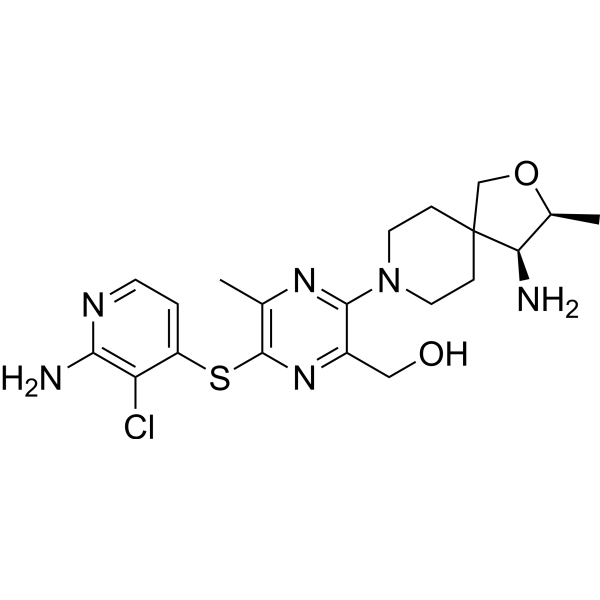
RMC-4630
CAS No. 2172652-48-9
RMC-4630( SHP2-IN-7 )
Catalog No. M28230 CAS No. 2172652-48-9
RMC-4630 is an inhibitor of SHP2.
Purity : >98% (HPLC)
 COA
Datasheet
HNMR
HPLC
MSDS
Handing Instructions
COA
Datasheet
HNMR
HPLC
MSDS
Handing Instructions
| Size | Price / USD | Stock | Quantity |
| 1 mL x 10 mM in DMSO | 358 | In Stock |


|
| 5MG | 325 | In Stock |
|
| 10MG | 520 | In Stock |
|
| 25MG | 851 | In Stock |
|
| 50MG | 1135 | In Stock |
|
| 100MG | 1535 | In Stock |
|
| 200MG | 2065 | In Stock |
|
| 500MG | Get Quote | In Stock |
|
| 1G | Get Quote | In Stock |
|
Biological Information
-
Product NameRMC-4630
-
NoteResearch use only, not for human use.
-
Brief DescriptionRMC-4630 is an inhibitor of SHP2.
-
DescriptionRMC-4630 is an inhibitor of SHP2.
-
In Vitro——
-
In Vivo——
-
SynonymsSHP2-IN-7
-
PathwayMetabolic Enzyme/Protease
-
TargetPhosphatase
-
RecptornAChR
-
Research Area——
-
Indication——
Chemical Information
-
CAS Number2172652-48-9
-
Formula Weight450.98
-
Molecular FormulaC20H27ClN6O2S
-
Purity>98% (HPLC)
-
SolubilityIn Vitro:?DMSO : 50 mg/mL (110.87 mM)
-
SMILESC[C@@H]1OCC(CC2)(CCN2c(nc2C)c(CO)nc2Sc2ccnc(N)c2Cl)[C@@H]1N
-
Chemical Name——
Shipping & Storage Information
-
Storage(-20℃)
-
ShippingWith Ice Pack
-
Stability≥ 2 years
Reference
1.Papke RL, et, al. Compositions et methodes d'inhibition selective des recepteurs nicotiniques de l'acetylcholine. WO2005032479A2
molnova catalog



related products
-
CCT007093
CCT007093 is a potent PPM1D (WIP1) inhibitor with IC50 of 8.4 μM.
-
MP07-66
MP07-66 is a novel FTY720-analog devoid of immunosuppressive effects leads to the reactivation of PP2A, which in turn triggers apoptosis of CLL cells.
-
Rosmanol
Rosmanol has antioxidant activity, it can activate the antioxidant response element. Rosmanol has biphasic modulation of GABAA receptors, demonstrates CNS activity in mouse models of antinociception, antidepressant and anxiolysis.
