


 Cart
Cart
 sales@molnova.com



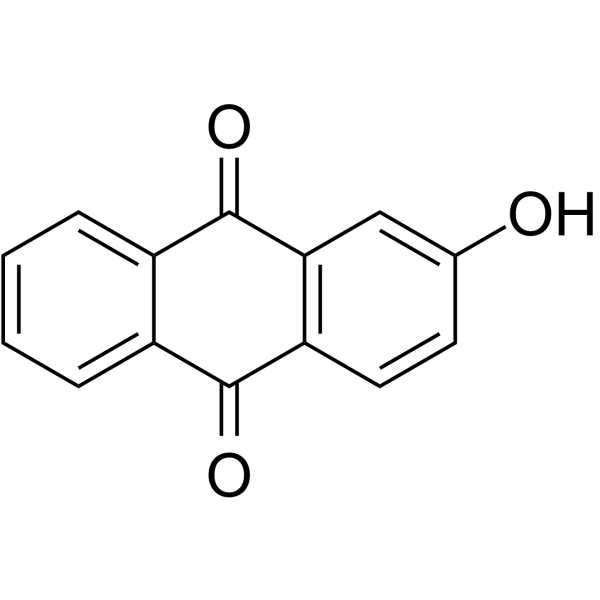
2-Hydroxyanthraquinone
CAS No. 605-32-3
2-Hydroxyanthraquinone( —— )
Catalog No. M28101 CAS No. 605-32-3
2-Hydroxyanthraquinone is an acetylated beta-D-glucoside with antitumour and immunosuppressive activity.
Purity : >98% (HPLC)
 COA
Datasheet
HNMR
HPLC
MSDS
Handing Instructions
COA
Datasheet
HNMR
HPLC
MSDS
Handing Instructions
| Size | Price / USD | Stock | Quantity |
| 1 mL x 10 mM in DMSO | 33 | In Stock |


|
| 100MG | Get Quote | In Stock |
|
| 200MG | Get Quote | In Stock |
|
| 500MG | 29 | In Stock |
|
| 1G | 37 | In Stock |
|
Biological Information
-
Product Name2-Hydroxyanthraquinone
-
NoteResearch use only, not for human use.
-
Brief Description2-Hydroxyanthraquinone is an acetylated beta-D-glucoside with antitumour and immunosuppressive activity.
-
Description2-Hydroxyanthraquinone is an acetylated beta-D-glucoside with antitumour and immunosuppressive activity.
-
In Vitro——
-
In Vivo——
-
Synonyms——
-
PathwayOthers
-
TargetOther Targets
-
RecptorAntibacterial|Antibiotic
-
Research Area——
-
Indication——
Chemical Information
-
CAS Number605-32-3
-
Formula Weight224.215
-
Molecular FormulaC14H8O3
-
Purity>98% (HPLC)
-
SolubilityIn Vitro:?DMSO : 100 mg/mL (446.01 mM)
-
SMILESOc1ccc2C(=O)c3ccccc3C(=O)c2c1
-
Chemical Name——
Shipping & Storage Information
-
Storage(-20℃)
-
ShippingWith Ice Pack
-
Stability≥ 2 years
Reference
1.Siti Nani Nurbaeti, et al. Sustained-release Microparticle Dry Powders of Chloramphenicol Palmitate or Thiamphenicol Palmitate Prodrugs for Lung Delivery as Aerosols.Eur J Pharm Sci. 2019 Oct 1;138:105028.
molnova catalog



related products
-
Guanidoacetic acid
Guanidinoacetic acid, a precursor of creatine, is a replacement of dietary arginine and could support overall energy homeostasis of the bird.
-
Mefexamide hydrochlo...
Mefexamide hydrochloride is a psychostimulant.
-
PAC1R antagonist 1
PAC1R antagonist 1 is an orally active PAC1 receptor antagonist that inhibits abnormal pain induced by pituitary adenylate cyclase-activating polypeptide (PACAP) and nerve damage, and may be used in the study of neoplasms and immune-related disorders.
