


 Cart
Cart
 sales@molnova.com



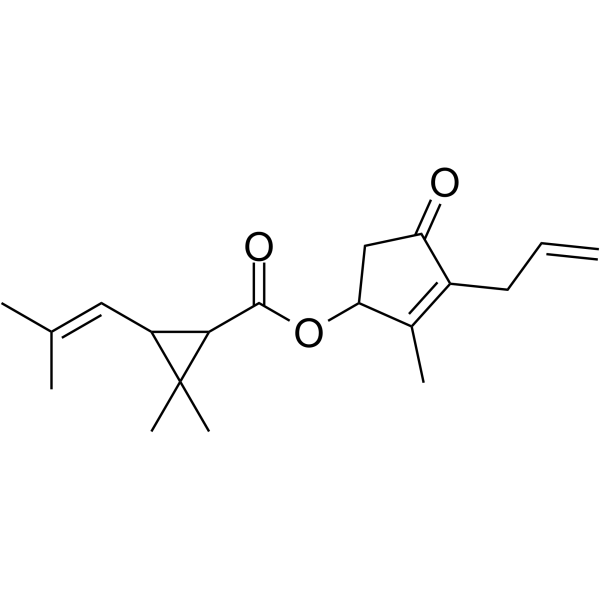
Allethrin
CAS No. 584-79-2
Allethrin( —— )
Catalog No. M27805 CAS No. 584-79-2
Allethrin induces oxidative stress, apoptosis and calcium release. Allethrin, a pyrethroid insecticide is a major mosquito repellent agent.
Purity : >98% (HPLC)
 COA
Datasheet
HNMR
HPLC
MSDS
Handing Instructions
COA
Datasheet
HNMR
HPLC
MSDS
Handing Instructions
| Size | Price / USD | Stock | Quantity |
| 1 mL x 10 mM in DMSO | 37 | In Stock |


|
| 25MG | 29 | In Stock |
|
| 50MG | 33 | In Stock |
|
| 100MG | 45 | In Stock |
|
| 200MG | 67 | In Stock |
|
| 500MG | 110 | In Stock |
|
| 1G | 161 | In Stock |
|
Biological Information
-
Product NameAllethrin
-
NoteResearch use only, not for human use.
-
Brief DescriptionAllethrin induces oxidative stress, apoptosis and calcium release. Allethrin, a pyrethroid insecticide is a major mosquito repellent agent.
-
DescriptionAllethrin induces oxidative stress, apoptosis and calcium release. Allethrin, a pyrethroid insecticide is a major mosquito repellent agent.(In Vitro):Allethrin (125 μM) induces BCL-2, caspase-3 activation and release of intracellular calcium. Morphological analyses of LC540 cells treated with Allethrin (125 μM) reveals the presence of apoptotic bodies. The percentage of cells displaying early apoptotic features increased significantly. (In Vivo):In male wistar rats aged 90 day,s Allethrin (25, 50, 100, and 150 mg/kg; every day for 60 days) increased lipid peroxidation in the caput, cauda, and testes. Significant increase in catalase activity was observed in the cauda obtained from 50, 100, and 150 mg/kg. GPx activity was significantly increased in the caput obtained from 150 mg/kg treated rats. In the cauda, it was found to be increased significantly in the 50 and 100 mg/kg treated groups. In contrast, the activity of GPx activity was significantly decreased in the testes of rats treated with 150 mg/kg. GST activity was found to be increased significantly in a dose dependent manner in the caput and cauda of allethrin treated rats.
-
In VitroAllethrin (0.001-250 μM) induces cytotoxicity and oxidative stress. Allethrin is cytotoxic to isolated Leydig cells and testicular cancer cells. Cytotoxicity is due to free radical generation and altered antioxidant status.Morphological analyses of LC540 cells treated with Allethrin (125 μM) reveals the presence of apoptotic bodies.Allethrin (125 μM) induces BCL-2, caspase-3 activation and release of intracellular calcium.Allethrin (IC50≈85 μM) is toxic to human corneal epithelial (HCE) cells causing death through mitochondrial pathway. Cell Cytotoxicity Assay Cell Line:LC540 cells (derived from rat Leydig cell tumor)Concentration:0.001-250 μM Incubation Time:24 hours Result:At low concentrations did not display appreciable cell killing activity up to 50 μM when incubated for 24 h. At concentrations above 100 μM, cell killing was observed. Based on the results obtained, the IC50 was 125 μM.Apoptosis Analysis Cell Line:LC540 cells Concentration:125 μM Incubation Time:24 hours Result:Revealed the presence of apoptotic bodies. The percentage of cells displaying early apoptotic features increased significantly.Western Blot Analysis Cell Line: LC540 cells Concentration:125 μM Incubation Time:0, 3, 6, 9, 12, 24 hours Result:BCL-2, pro-Caspase-3 and PARP-1 protein expression decreased significantly with an increase in cleaved PARP-1 levels.
-
In VivoAdult male rats are treated orally with Allethrin (25, 50, 100, and 150 mg/kg; every day for 60 days). Lipid peroxidation is increased in the caput, cauda, and testes. Nitric oxide production is increased in the caput, but unaltered in the cauda and testes. The activities of catalase, glutathione peroxidase (GPx), glutathione-S-transferase (GST), and superoxide dismutase (SOD) are decreased in the caput and cauda. Animal Model:Male Wistar rats aged 90 days.Dosage:25, 50, 100, and 150 mg/kg Administration:Orally administered every day for 60 daysResult:Increased levels of LPO products were observed in the caput, cauda, and testes of allethrin treated rats. In the caput, increased levels of NO was observed at all the doses tested, when compared with the vehicle treated control. Significant increase in catalase activity was observed in the cauda obtained from 50, 100, and 150 mg/kg. GPx activity was significantly increased in the caput obtained from 150 mg/kg treated rats. In the cauda, it was found to be increased significantly in the 50 and 100 mg/kg treated groups. In contrast, the activity of GPx activity was significantly decreased in the testes of rats treated with 150 mg/kg.GST activity was found to be increased significantly in a dose dependent manner in the caput and cauda of allethrin treated rats. In the caput, significant increase in the activity of SOD was observed in the 150 mg/kg body treated rats. In the cauda and testes, treatment resulted in increase of SOD activity at all the doses tested.
-
Synonyms——
-
PathwayAngiogenesis
-
TargetBcl-2
-
Recptor——
-
Research Area——
-
Indication——
Chemical Information
-
CAS Number584-79-2
-
Formula Weight302.414
-
Molecular FormulaC19H26O3
-
Purity>98% (HPLC)
-
Solubility——
-
SMILESCC(C)=CC1C(C(=O)OC2CC(C)=C(CC=C)C2=O)C1(C)C
-
Chemical Name——
Shipping & Storage Information
-
Storage(-20℃)
-
ShippingWith Ice Pack
-
Stability≥ 2 years
Reference
1.Amir Hanna-Elias, et al. Synthesis and preliminary screening of novel indole-3-methanamines as 5-HT4 receptor ligands. European Journal of Medicinal Chemistry, Volume 44, Issue 7, 2009, Pages 2952-2959.
molnova catalog



related products
-
MIM1
A potent, selective small molecule Mcl-1 inhibitor that selectively targets the BH3-binding groove of Mcl-1.
-
BI-3802
BI-3802 (BI3802) is a highly potent and efficacious BCL6 degrader that potently inhibits the interaction of the BTB/POZ domain of BCL6 with several co-repressors in vitro with IC50 of <3 nM.
-
S-63845
S-63845 (S63845)?is a highly potent, selective Mcl-1 inhibitor with Kd of 0.19 nM.
