


 Cart
Cart
 sales@molnova.com



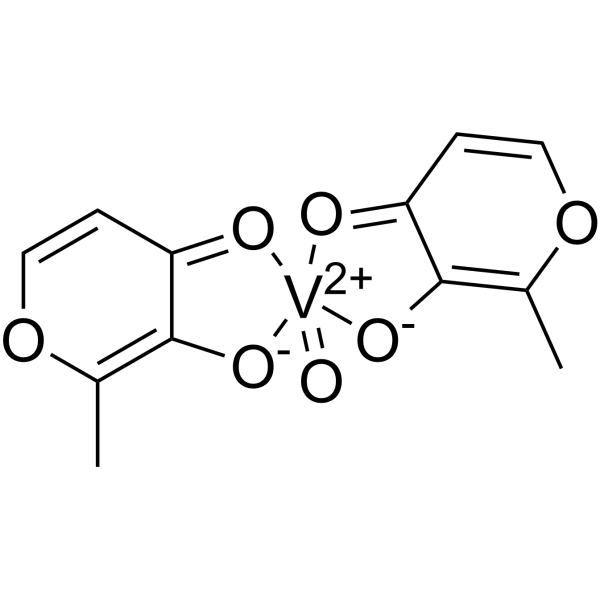
Bis(maltolato)oxovanadium(IV)
CAS No. 38213-69-3
Bis(maltolato)oxovanadium(IV)( BMOV | Bis(maltolato)oxovanadium (IV) )
Catalog No. M27534 CAS No. 38213-69-3
BMOV is a potent, reversible, competitive and orally active pan-PTP (protein tyrosine phosphatases)inhibitor with insulin-mimicking effects and anti-diabetic properties.
Purity : >98% (HPLC)
 COA
Datasheet
HNMR
HPLC
MSDS
Handing Instructions
COA
Datasheet
HNMR
HPLC
MSDS
Handing Instructions
| Size | Price / USD | Stock | Quantity |
| 1 mL x 10 mM in DMSO | 41 | In Stock |


|
| 5MG | 37 | In Stock |
|
| 10MG | 56 | In Stock |
|
| 25MG | 116 | In Stock |
|
| 50MG | 183 | In Stock |
|
| 100MG | 291 | In Stock |
|
| 200MG | 435 | In Stock |
|
| 500MG | 700 | In Stock |
|
| 1G | Get Quote | In Stock |
|
Biological Information
-
Product NameBis(maltolato)oxovanadium(IV)
-
NoteResearch use only, not for human use.
-
Brief DescriptionBMOV is a potent, reversible, competitive and orally active pan-PTP (protein tyrosine phosphatases)inhibitor with insulin-mimicking effects and anti-diabetic properties.
-
DescriptionBMOV is a potent, reversible, competitive and orally active pan-PTP (protein tyrosine phosphatases)inhibitor with insulin-mimicking effects and anti-diabetic properties. BMOV is a potent insulin sensitize. BMOV is shown to improve cardiac dysfunctions in diabetic models. BMOV inhibits HCPTPA, PTP1B, HPTPβ and SHP2 with IC50s of 126 nM, 109 nM, 26 nM and 201 nM, respectivelyr.(In Vitro):BMOV treatment enhances the phosphorylation of the insulin receptor and of the insulin signalling key intermediate Akt. BMOV treatment also resultes in an increased glucose uptake in C2C12 cells.(In Vivo):BMOV (0.75-3.0 mmol; intraperitoneal injection; twice weekly; for 6 weeks; Male C57BL/6J mice) treatment ameliorates the metabolic phenotype, as evidenced by reduced body weight, improved insulin sensitivity and glucose tolerance.
-
In VitroBis(maltolato)oxovanadium(IV) treatment enhances the phosphorylation of the insulin receptor and of the insulin signalling key intermediate Akt. Bis(maltolato)oxovanadium(IV) (BMOV; 50 μM) treatment also resultes in an increased glucose uptake in C2C12 cells.
-
In VivoBis(maltolato)oxovanadium(IV) (BMOV; 0.75-3.0 mmol; intraperitoneal injection; twice weekly; for 6 weeks; C57BL/6J mice) treatment ameliorates the metabolic phenotype. Liver, skeletal muscle, and adipose tissue revealed a significantly reduced PTP activity in all analysed tissues compared to HFD mice. Animal Model:C57BL/6J mice (4-6 weeks) fed with high-fat diet (HFD) Dosage:0.75-3.0 mmol Administration:Intraperitoneal injection; twice weekly; for 6 weeks Result:Ameliorated the metabolic phenotype, as evidenced by reduced body weight, improved insulin sensitivity and glucose tolerance.
-
SynonymsBMOV | Bis(maltolato)oxovanadium (IV)
-
PathwayMetabolic Enzyme/Protease
-
TargetPhosphatase
-
RecptorApoptosis
-
Research Area——
-
Indication——
Chemical Information
-
CAS Number38213-69-3
-
Formula Weight317.15
-
Molecular FormulaC12H10O7V
-
Purity>98% (HPLC)
-
SolubilityIn Vitro:?DMSO : 25 mg/mL (78.83 mM)
-
SMILESCC(OC=C1)=C([O-]2)C1=O[V+2]23(O=C4C=COC(C)=C4[O-]3)=O
-
Chemical Name——
Shipping & Storage Information
-
Storage(-20℃)
-
ShippingWith Ice Pack
-
Stability≥ 2 years
Reference
1.Ha TJ, Kubo I. Lipoxygenase inhibitory activity of anacardic acids. J Agric Food Chem. 2005 Jun 1;53(11):4350-4.
molnova catalog



related products
-
L-Ascorbic acid 2-ph...
L-Ascorbic acid 2-phosphate magnesium (2-Phospho-L-ascorbic acid magnesium) is a long-acting vitamin C derivative that can stimulate collagen formation and expression.
-
Cis-5-Norbornene-exo...
Cis-5-Norbornene-exo-2,3-dicarboxylic Anhydride may cause sensitization. Cis-5-Norbornene-exo-2,3-dicarboxylic Anhydride promotes apoptosis in HepG2 (IC50= 62 μM) and SK-Hep1 (IC50= 151 μM) cells and inhibits protein phosphatase 2A.
-
1-Naphthyl phosphate...
1-Naphthyl phosphate potassium salt inhibits non-specific phosphatase.
