


 Cart
Cart
 sales@molnova.com



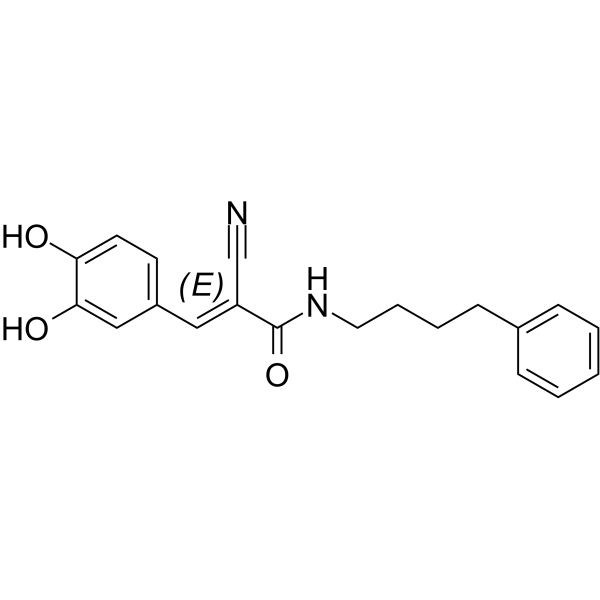
(E)-AG 556
CAS No. 133550-41-1
(E)-AG 556( (E)-Tyrphostin AG 556 )
Catalog No. M27474 CAS No. 133550-41-1
AG 556 is a selective inhibitor of EGFR and blocks LPS-induced TNF-α production.
Purity : >98% (HPLC)
 COA
Datasheet
HNMR
HPLC
MSDS
Handing Instructions
COA
Datasheet
HNMR
HPLC
MSDS
Handing Instructions
| Size | Price / USD | Stock | Quantity |
| 10MG | 29 | In Stock |


|
| 25MG | 56 | In Stock |
|
| 50MG | 85 | In Stock |
|
| 100MG | 136 | In Stock |
|
| 200MG | Get Quote | In Stock |
|
| 500MG | Get Quote | In Stock |
|
| 1G | Get Quote | In Stock |
|
Biological Information
-
Product Name(E)-AG 556
-
NoteResearch use only, not for human use.
-
Brief DescriptionAG 556 is a selective inhibitor of EGFR and blocks LPS-induced TNF-α production.
-
DescriptionAG 556 is a selective inhibitor of EGFR and blocks LPS-induced TNF-α production.
-
In Vitro——
-
In Vivo——
-
Synonyms(E)-Tyrphostin AG 556
-
PathwayAngiogenesis
-
TargetEGFR
-
Recptor——
-
Research Area——
-
Indication——
Chemical Information
-
CAS Number133550-41-1
-
Formula Weight336.38
-
Molecular FormulaC20H20N2O3
-
Purity>98% (HPLC)
-
SolubilityIn Vitro:?DMSO : 100 mg/mL (297.28 mM)
-
SMILESN#C/C(/C(NCCCCc1ccccc1)=O)=C\c(cc1)cc(O)c1O
-
Chemical Name——
Shipping & Storage Information
-
Storage(-20℃)
-
ShippingWith Ice Pack
-
Stability≥ 2 years
Reference
1.Qa'dan F, et al. Cinchonain Ib isolated from Eriobotrya japonica induces insulin secretion in vitro and in vivo. J Ethnopharmacol. 2009 Jul 15;124(2):224-7.
molnova catalog



related products
-
Gefitinib
A potent, selective, orally active EGFR inhibitor with IC50 of 23 nM; inhibits EGF-stimulated proliferation of KB cells with IC50 of 80 nM.
-
SDZ281-977
SDZ 281-977 is a derivative of Lavendustin A, an EGF receptor tyrosine kinase inhibitor.
-
PD153035 hydrochlori...
PD153035 hydrochloride (ZM 252868; AG 1517) is a potent and specific inhibitor of EGFR with Ki and IC50 of 5.2 pM and 29 pM; little effect against PGDFR, FGFR, CSF-1, InsR and Src.
