


 Cart
Cart
 sales@molnova.com



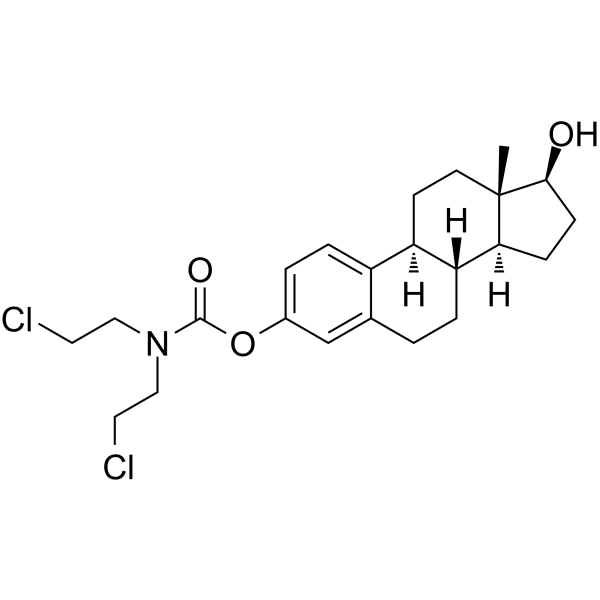
Estramustine
CAS No. 2998-57-4
Estramustine( NSC89201 | LEO275 )
Catalog No. M27308 CAS No. 2998-57-4
Estramustine is a nitrogen mustard linked to estradiol, usually as phosphate. Estramustine has been used to treat prostatic neoplasms; also has radiation protective properties.
Purity : >98% (HPLC)
 COA
Datasheet
HNMR
HPLC
MSDS
Handing Instructions
COA
Datasheet
HNMR
HPLC
MSDS
Handing Instructions
| Size | Price / USD | Stock | Quantity |
| 1 mL x 10 mM in DMSO | 44 | In Stock |


|
| 5MG | 37 | In Stock |
|
| 10MG | 61 | In Stock |
|
| 25MG | 122 | In Stock |
|
| 50MG | 198 | In Stock |
|
| 100MG | 323 | In Stock |
|
| 200MG | 476 | In Stock |
|
| 500MG | Get Quote | In Stock |
|
| 1G | Get Quote | In Stock |
|
Biological Information
-
Product NameEstramustine
-
NoteResearch use only, not for human use.
-
Brief DescriptionEstramustine is a nitrogen mustard linked to estradiol, usually as phosphate. Estramustine has been used to treat prostatic neoplasms; also has radiation protective properties.
-
DescriptionEstramustine is a nitrogen mustard linked to estradiol, usually as phosphate. Estramustine has been used to treat prostatic neoplasms; also has radiation protective properties. Estramustine is selectively taken up by prostate cells and exerts antineoplastic effects by interfering with microtubule of dynamics and by reducing plasma levels of testosterone.
-
In Vitro——
-
In Vivo——
-
SynonymsNSC89201 | LEO275
-
PathwayCytoskeleton/Cell Adhesion Molecules
-
TargetMicrotubule/Tubulin
-
RecptorEphrin Receptor
-
Research Area——
-
Indication——
Chemical Information
-
CAS Number2998-57-4
-
Formula Weight440.4
-
Molecular FormulaC23H31Cl2NO3
-
Purity>98% (HPLC)
-
SolubilityIn Vitro:?DMSO : 100 mg/mL (227.07 mM)
-
SMILESC[C@@]12[C@@H](O)CC[C@@]1([H])[C@]3([H])CCC4=C(C=CC(OC(N(CCCl)CCCl)=O)=C4)[C@@]3([H])CC2
-
Chemical Name——
Shipping & Storage Information
-
Storage(-20℃)
-
ShippingWith Ice Pack
-
Stability≥ 2 years
Reference
1.Wu B, et al. Potent and Selective EphA4 Agonists for the Treatment of ALS. Cell Chem Biol. 2017 Mar 16;24(3):293-305.
molnova catalog



related products
-
Colchicine
Colchicine is a tubulin inhibitor, it blocks polymerization of microtubules by binding to tubulin (IC50 = 3.2 μM).
-
Lexibulin
An orally active tubulin polymerization inhibitor with potent cytotoxic and vascular disrupting activity in vitro and in vivo.
-
FiVe1
FiVe1 is a vimentin binding small molecule that promotes vimentin disorganization and phosphorylation during metaphase.
