


 Cart
Cart
 sales@molnova.com



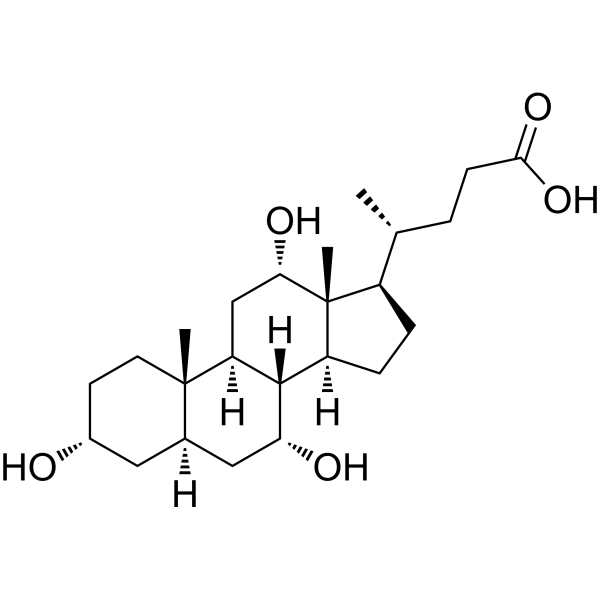
Allocholic acid
CAS No. 2464-18-8
Allocholic acid( —— )
Catalog No. M27062 CAS No. 2464-18-8
Allocholic acid is a major component in bile from the river carpsucker, Carpiodes carpio.
Purity : >98% (HPLC)
 COA
Datasheet
HNMR
HPLC
MSDS
Handing Instructions
COA
Datasheet
HNMR
HPLC
MSDS
Handing Instructions
| Size | Price / USD | Stock | Quantity |
| 1 mL x 10 mM in DMSO | 48 | In Stock |


|
| 10MG | 48 | In Stock |
|
| 50MG | 91 | In Stock |
|
| 100MG | 135 | In Stock |
|
| 200MG | Get Quote | In Stock |
|
| 500MG | Get Quote | In Stock |
|
| 1G | Get Quote | In Stock |
|
Biological Information
-
Product NameAllocholic acid
-
NoteResearch use only, not for human use.
-
Brief DescriptionAllocholic acid is a major component in bile from the river carpsucker, Carpiodes carpio.
-
DescriptionAllocholic acid is a major component in bile from the river carpsucker, Carpiodes carpio. Allocholic acid is a potent and specific stimulant of the adult olfactory system and function as migratory pheromones in lamprey.
-
In Vitro——
-
In Vivo——
-
Synonyms——
-
PathwayOthers
-
TargetOther Targets
-
RecptorAminopeptidase| Epoxide Hydrolase
-
Research Area——
-
Indication——
Chemical Information
-
CAS Number2464-18-8
-
Formula Weight408.579
-
Molecular FormulaC24H40O5
-
Purity>98% (HPLC)
-
SolubilityIn Vitro:?DMSO : 33.33 mg/mL (81.58 mM)
-
SMILES[H][C@@]12CC[C@H]([C@H](C)CCC(O)=O)[C@@]1(C)[C@@H](O)C[C@@]1([H])[C@@]2([H])[C@H](O)C[C@@]2([H])C[C@H](O)CC[C@]12C
-
Chemical Name——
Shipping & Storage Information
-
Storage(-20℃)
-
ShippingWith Ice Pack
-
Stability≥ 2 years
Reference
1.El-Naggar MH, et al. Synthesis, docking, cytotoxicity, and LTA4H inhibitory activity of new gingerol derivatives as potential colorectal cancer therapy. Bioorg Med Chem. 2017;25(3):1277-1285.
molnova catalog



related products
-
PA-8
PA-8 is a small molecule receptor antagonist for PACAP Type I (PAC1) that is selective, effective, and orally active. PA-8 inhibits PacAP-induced CREB phosphorylation at PAC1- receptors, but does not inhibit VPAC1- or vpac2 receptors.
-
S Tag Peptide
S Tag Peptide is a 15 amino acid peptide derived from RNase A.
-
6,7-Dimethoxy-4-phen...
The heartwoods of Dalbergia sissoo.
